Is Zero Sugar Soda Really Sugar-Free? Korean Lab Data
The assumption behind a lot of "zero" cans is that zero sugar means the drink is less sweet, low in calories, or both. Korea's Ministry of Food and Drug Safety (MFDS, 식약처) said in 2024 that this is the confusion it wanted to prevent, and it changed the labeling rules to address it. Two sets of Korean lab results, one from this week and one from 2024, put actual numbers on the first part of that assumption.
The test published on October 3
The Chungbuk Health and Environment Research Institute (충북보건환경연구원) tested 53 drinks sold in North Chungcheong Province that carried low-sugar, zero-sugar or similar sugar claims. Gukje News reported the results at 11:45 KST on October 3, 2026 (02:45 UTC). By category, the 53 were 8 fruit and vegetable drinks, 21 other beverages, 16 carbonated drinks, 7 coffees and 1 processed soy milk, according to Newsis.
Measured sugar across all 53 was 0.018 to 2.209 g per 100 g, with an average of 0.706 g. The zero-labeled products ranged from 0.075 to 0.416 g per 100 g and averaged 0.222 g. The low-sugar products ranged from 0.037 to 2.209 g with an average of 0.834 g. Every product met its labeling standard.
Most people have never seen the standard itself. A drink can say "zero" (무당) at under 0.5 g of sugar per 100 g or 100 ml. "Low sugar" (저당) means under 5 g per 100 g or under 2.5 g per 100 ml. So a zero label permits some sugar. In this sample the highest zero-labeled drink, 0.416 g, was still below the limit.
The report states its figures per 100 g, while the low-sugar limit for liquids is written per 100 ml. For a watery drink the two are close, so the 2.209 g maximum sits just under the 2.5 g cap, but that comparison is mine and approximate.
What the Consumer Agency found in 2024
The Korea Consumer Agency (한국소비자원) ran a broader test of 14 popular zero drinks and published it on August 2, 2024 as Comparison Report 2024-13. It picked the products from a survey of 1,000 consumers who had drunk a zero beverage in the previous three months. The list included Coca-Cola Zero, Sprite Zero, Chilsung Cider Zero and Milkis Zero.
Thirteen of the 14 had no detectable sugar. Milkis Zero measured 0.4 g per 100 ml, under the 0.5 g line. On a 250 ml can that works out to about 1 g (my arithmetic). The agency set that against ordinary sweetened soda at 10 g per 100 ml.
Calories were low but not all zero. Thirteen of the 14 had 3 kcal or less per 100 ml. The exception was Mierohwaibeo Sparkling Zero (미에로화이바 스파클링 제로, Hyundai Pharm) at 9 kcal per 100 ml, of which the agency attributes 6 kcal to dietary fiber. Per can, the zero drinks came to 2 to 32 kcal against 144 kcal for a regular sweetened soda, which the agency expressed as 1 to 22 percent.
Something has to replace the sugar. All 14 drinks used acesulfame potassium and sucralose, at 7 to 20 mg and 14 to 27 mg per 100 ml respectively. Five carried additional sweeteners. One used aspartame, four used allulose and one used erythritol, and one product had two of them. The agency's table lists 1.8 g of allulose per 100 ml for Milkis Zero, separate from its measured sugar. Per can, the acesulfame potassium and the sucralose each came to 3 to 13 percent of the acceptable daily intake for a 60 kg adult.
Where "zero" stops meaning what people assume
Sugar was the one claim the labs could confirm. On health, the Consumer Agency was blunt:
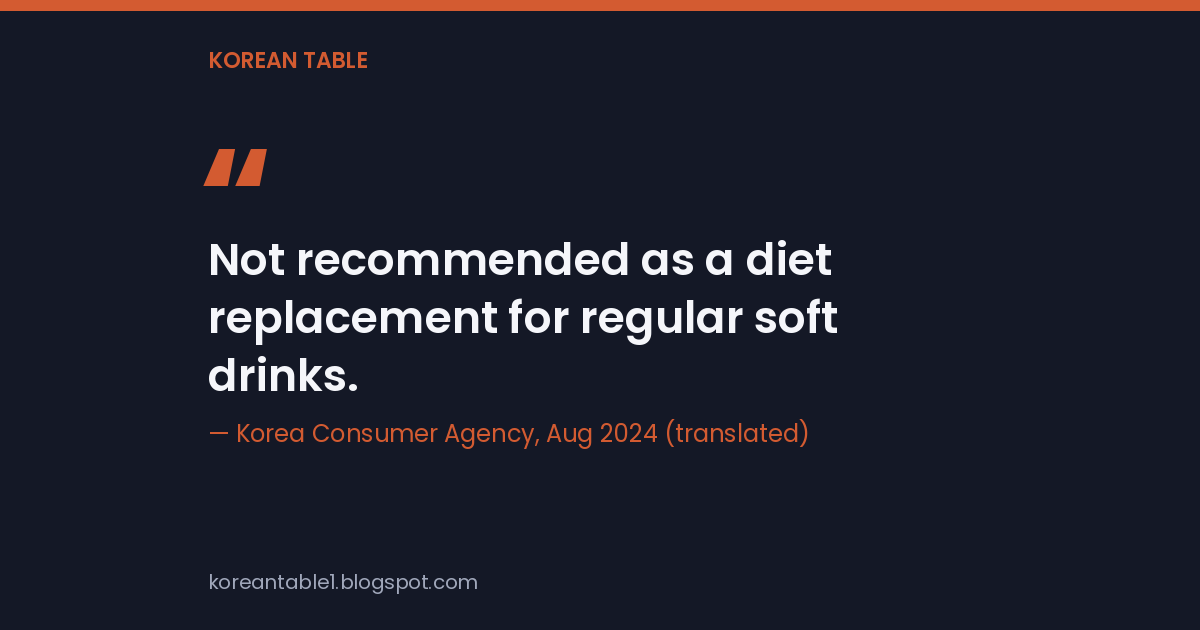
The agency's own wording is 다이어트를 위해 일반음료의 대체품으로 섭취하는 것은 권장하지 않는다, and the translation is mine. It also notes that the World Health Organization advises against using sweeteners as a means of weight control or disease reduction, and suggests water instead.
Caffeine is another thing "zero" does not remove. The four cola-type products held 3 to 13 mg per 100 ml, against 10 mg in an ordinary sweetened cola. For a 30 kg child, the agency calculated that two or more cans of the strongest one (46 mg per can) could pass the 75 mg daily recommendation.
Price is the last gap. In July 2024 the agency found zero cola and regular cola both at 560 won per 100 ml in convenience stores. Across the 14 products, the range ran from 140 won per 100 ml (E-mart's No Brand Cola Zero) to 630 won (Mierohwaibeo Sparkling Zero).
The label change scheduled for January 2026
The MFDS rule revision announced on July 24, 2024 applies the same worry to packaging. Per Nongmin, foods that stress "zero sugar", "no sugar" or "no added sugar" must, from January 2026, state whether a sweetener is present and give calorie information. That start date has already passed, and I did not check any shelf or any later report to see whether cans now carry it. An MFDS official told the paper the aim was to stop consumers from thinking such a product is less sweet or lower in calories. ZDNet Korea reports the same January 1, 2026 start date.
If you pick up a Korean zero drink now, the rule as reported calls for the words 감미료 함유 (contains sweetener) near the "zero" claim, along with calorie information.
One caution on dates. The Consumer Agency tested 2024 products, so formulas may have changed since. The Chungbuk sample covers one province's shelves, and the news reports I read give averages and ranges but no brand names.
This is a running series, not a one-off post — a new post goes up every day, at around 9am Korea time.
About · Contact · Privacy Policy
Read next: Korean Laver (Gim) Iodine: 100 mg/kg vs 2,432 for Kelp · Korean Sweet Potato Types: Bam, Hobak and the Japanese Honey One · Bean Sprout Tails: Trim or Keep? Korean Lab Numbers by Part


Comments
Post a Comment