Korean Sweet Potato Types: Bam, Hobak and the Japanese Honey One
Korean sweet potato types come down to three Korean words, 밤고구마 (bam-goguma, "chestnut sweet potato"), 호박고구마 (hobak-goguma, "pumpkin sweet potato") and 꿀고구마 (kkul-goguma, "honey sweet potato"). They describe texture and sweetness, and the variety name behind each word has been changing.
In a 2019 piece, Real Foods, a Korean food news site, listed those three as the commonly known types and put a variety in brackets next to each: 율미 (Yulmi) for chestnut, 안노베니 (Annobeni) for pumpkin and 베니하루카 (Beniharuka) for honey. Beniharuka is a Japanese seed. According to experts quoted by Nongmin Shinmun in June 2025, that Japanese variety "had been dominating" (좌지우지해왔다) the Korean sweet potato market.
Chestnut, pumpkin, honey: what the words mean in the pot
The Korean agricultural terms are 분질 (bunjil, floury) and 점질 (jeomjil, moist and sticky). A 2019 field guide from the Rural Development Administration (RDA) pairs them directly: "점질(호박)고구마" and "분질(밤)고구마".
The same RDA guide gives one growing difference. Moist pumpkin types size up later than floury chestnut types, so the agency advises growing them for at least 140 days before harvest.
The Real Foods descriptions, type by type, in my translation from the 2019 article:
- Bam-goguma (chestnut): does not crumble much when roasted or steamed, and has little moisture
- Hobak-goguma (pumpkin): lighter in color than other types, yellow when cut raw, high in sugar; good steamed, roasted or dried as goguma-mallaengi (고구마말랭이)
- Kkul-goguma (honey): halfway between the other two, sweet enough to earn the name, and firm enough to use in many dishes
The same article reported beta-carotene at 9,826 µg per 100 g in pumpkin sweet potato against 31 µg in chestnut sweet potato. Real Foods did not name the database or study behind those two numbers.
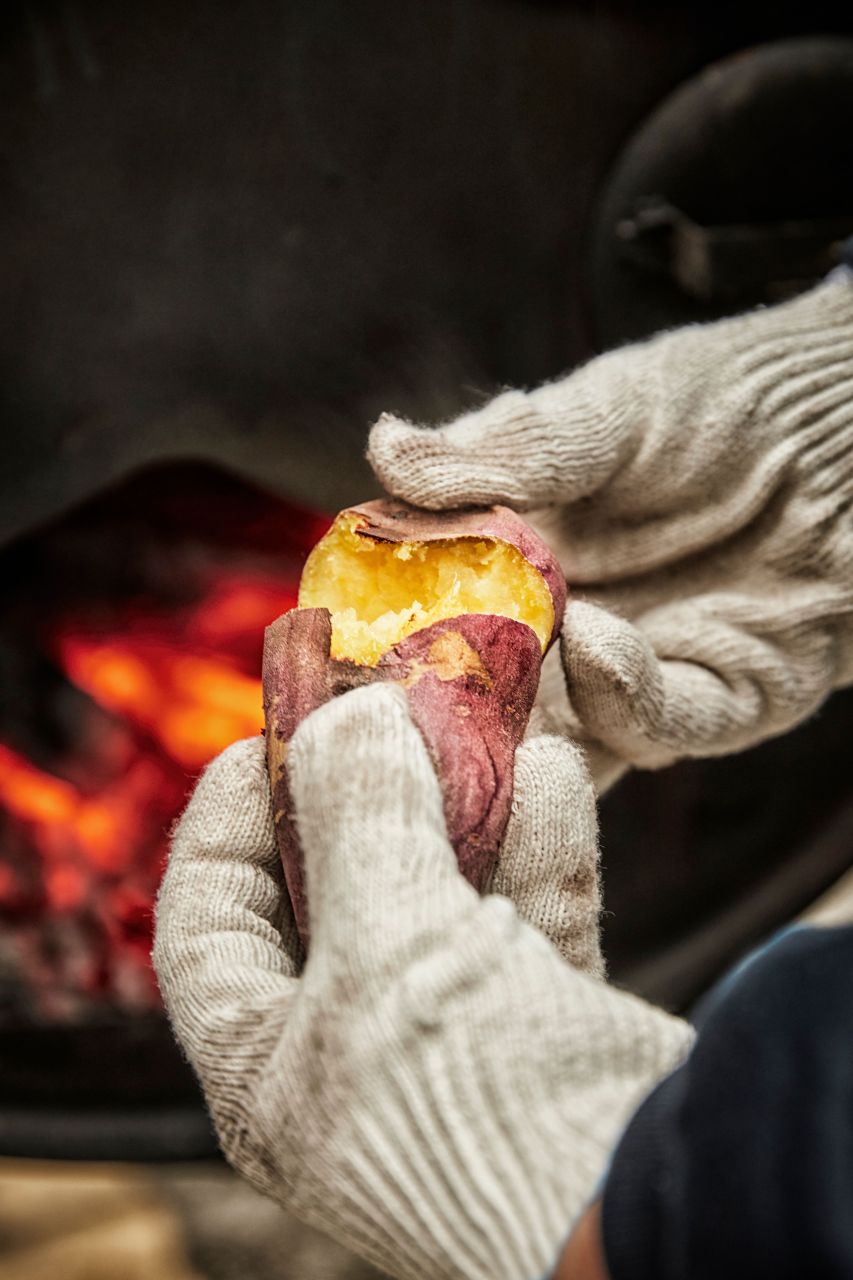
Going only by those descriptions, my own choice would be the moist pumpkin type for a mash or a goguma latte, and the chestnut type for roasting whole when you want slices that stay in one piece. The honey type sits between them, so it is the safer buy when you do not know yet what you will cook.
The honey one was Japanese, and that is changing
In its June 2025 report, Nongmin Shinmun explained why farmers started to switch. In 2018, when Mokpo had 31 heatwave days, an RDA yield trial in Muan measured Beniharuka at 13.8 tonnes per hectare. That was 68% of its 2019 yield (20.3 t), a year with 6 heatwave days. The domestic variety 호풍미 (Hopungmi) gave 50 t in 2018 against 54.3 t in 2019, a drop of 8%.
Hopungmi is a pumpkin type the RDA developed in 2021. By 2024 it covered 1,556 ha nationwide, which the same article put in 2위 (second place) among varieties, at 8.5%.
A year later the numbers moved again. Yeongnong Jajae Shinmun (newsfm), citing the RDA in November 2025, reported that the share of domestic varieties rose from 14.9% in 2016 to 41.1% in 2025. Their growing area went from 2,548 ha to 7,151 ha over the same period. Hopungmi alone reached 16.5% (2,860.7 ha) of the total and ranked 1위 by area.
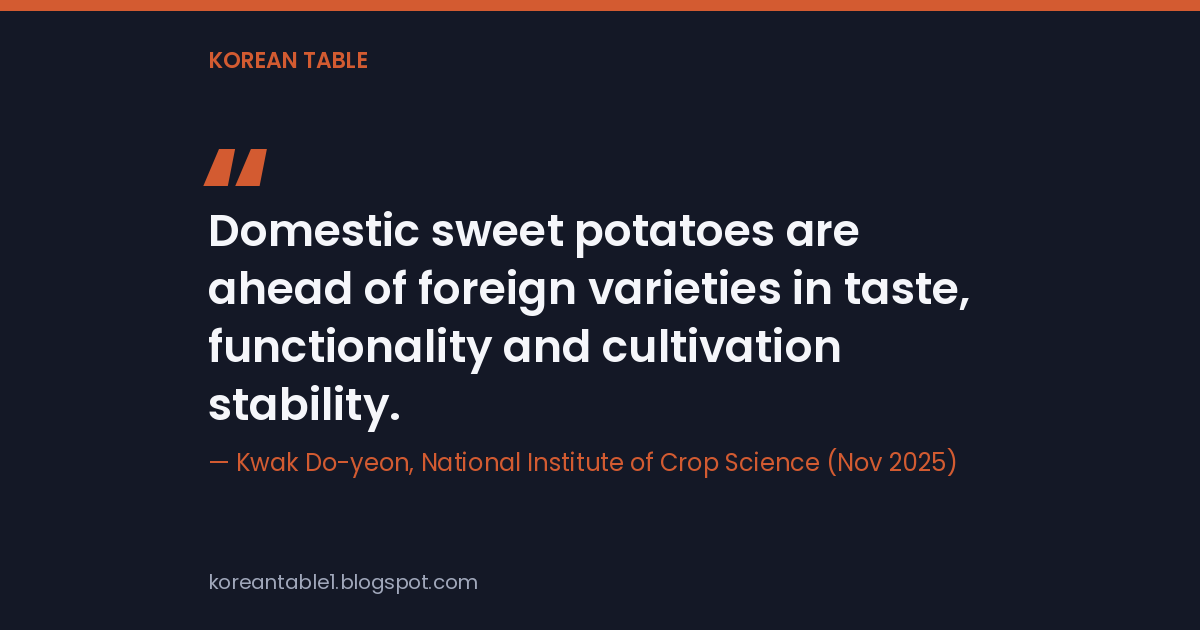
That line is from Kwak Do-yeon, head of the National Institute of Crop Science, in the same newsfm article. The RDA's stated target is 50% domestic share by 2030.
The 2019 article tied the word 꿀고구마 to Beniharuka. In March 2025, Newsis described the RDA's own 소담미 (Sodammi) as a 꿀고구마 that becomes sweeter and softer during storage. So the same honey label on a Korean box can now mean a Japanese variety or a Korean one.
Storage: 13 to 15°C, which is warmer than your fridge
In a September 2023 storage guide, the National Institute of Horticultural and Herbal Science put sweet potatoes in their own line: "고구마는 13∼15도에 저장하는 것이 좋다" (sweet potatoes are best stored at 13 to 15°C). A normal home refrigerator runs colder than that. The same guide gives 4 to 8°C for potatoes and 0°C for garlic, onions and carrots.
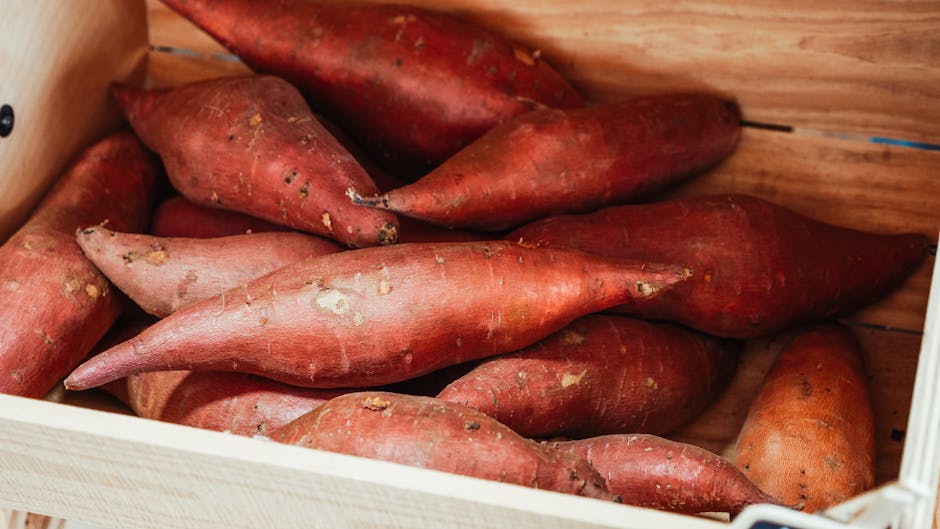
Before that storage stage, Korean farms cure the roots. 아물이 (amuri) is the Korean word, and it means letting the skin wounds heal.
The RDA's 2025 standard, reported by Pressian, is 35°C, 95% relative humidity and airflow of at least 1.9 m per second for 3 days. Sweet potatoes cured that way and then kept for 5 months in a farm store at 14°C and 85% humidity had a loss rate (감모율, the share lost between harvest and sale) of 5.6% and a rot rate of 3.0%. The farms' usual method gave 8.3% and 18.3%.
A 2018 paper in the Journal of the Korean Society of International Agriculture (vol. 30, no. 1) cured roots at 32°C and 92% humidity for 3 days, then stored them at 13°C for 30 weeks. For four varieties (Hogammi, Pungwonmi, Singeonmi, Juhwangmi), the uncured roots had 20% more decayed weight. Two others, Dahomi and Yeonjami, showed no significant difference.
At home you cannot do much about curing. You can, however, keep a bag of goguma out of the fridge and somewhere near that 13 to 15°C band, which in a heated apartment probably means a cupboard away from the heater.
The RDA also has a Q&A video on sweet potatoes on its own YouTube channel, titled in Korean.
Buying goguma outside Korea
At a Korean grocery such as H Mart, the useful information is the Hangul on the box or the shelf tag, where 밤, 호박 or 꿀 would sit in front of 고구마. I have not checked which of the three any overseas chain stocks this autumn.
Which word is printed on the goguma box at your store?
This is a running series, not a one-off post — a new post goes up every day, at around 9am Korea time.
About · Contact · Privacy Policy
Read next: Korean Rice Cake vs Mochi: Why Tteok Hardens and Mochi Doesn't · Does Gochujang Need to Be Refrigerated After Opening? Yes, Mostly · Kimchi Too Sour? How to Fix It, and What to Cook With It Instead


Comments
Post a Comment