Kimchi Probiotic Counts by Fermentation Stage
Whether store-bought kimchi is still alive, and whether a jar fermented in the fridge ends up with fewer lactic acid bacteria than one left on the counter, are two questions with published counts behind them. Four papers are collected below, each one with its temperature, its duration and its sample attached.
None of these studies measures "probiotics" in any regulated sense, and none of them follows the bacteria past the plate. The unit throughout is the colony-forming unit, one cell alive enough at sampling to grow into a visible colony.

From under-ripe to properly sour
The World Institute of Kimchi keeps a public explainer page on kimchi lactic acid bacteria, posted 17 May 2024. It puts the early, under-ripe stage at about 100,000 lactic acid bacteria per gram of kimchi, with acidity below 0.3%, and 적숙기 (jeoksukgi), the properly ripened stage, at more than 100 million per gram, with acidity running 0.3–0.8%. A thousandfold difference separates the two stages, and the genera the page names as the main fermenters are Lactobacillus, Leuconostoc and Weissella.

Fridge and counter land on the same peak
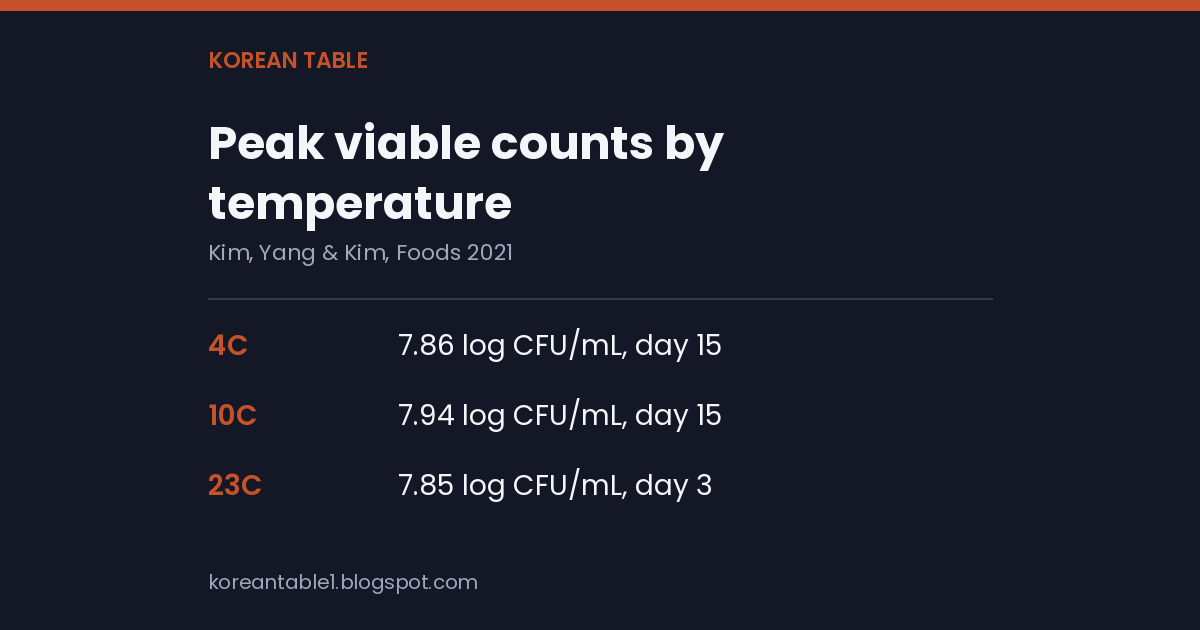
Kim, Yang and Kim fermented cabbage kimchi at 4°C, 10°C and 23°C and counted viable cells along the way (Foods, 2021). The peaks were 7.86 ± 0.10 log CFU/mL at 4°C, reached on day 15; 7.94 ± 0.06 at 10°C, also day 15; and 7.85 ± 0.05 at 23°C, reached on day 3. Those three sit inside each other's error bars. The calendar moved instead, three days at room temperature against fifteen in the fridge.
One unit caution before those figures travel anywhere. The 2021 counts are per milliliter of a homogenate and the institute's are per gram of kimchi, so the two bases differ. That homogenate was 25 g of kimchi blended into 225 mL of 0.85% saline.
The species differed by temperature. At 4°C, Latilactobacillus sakei held the middle stage and Leuconostoc mesenteroides took over late. At 10°C and 23°C, Levilactobacillus brevis and Lactiplantibacillus plantarum stayed relatively stable to the end. The kimchi was a fish-sauce recipe, made in the lab: salted cabbage mixed with red pepper 7.4%, radish 56.7%, green onion 5.3%, garlic 7.9%, ginger 1.1%, sugar 0.7%, saeu-jeotgal 10.5% and myeolchi-aekjeot 10.5%. Those percentages are of that ingredient mix, not of the finished jar. (A jar built without the jeotgal is a different question, and the umami numbers for that are in Kimchi Without Fish Sauce.)
If your fridge jar seems to be doing nothing in week one, Why Your Kimchi Isn't Fermenting covers the salt and temperature side of that.
Pasteurized kimchi does not stay near zero
Lee, Jeong, Park and Yoo pasteurized kimchi in a water bath at 55°C and 65°C for 30 minutes, then stored it at 4°C for four weeks (Food Science & Nutrition, 2019, 7(2):711–720). The sample is the condition to keep in view. It was a model baek-kimchi, a white kimchi built to minimize the ingredient variables. No red pepper in it, and nothing bought off a shelf.
Total viable bacteria, in log CFU/g:
| Treatment | Day 0 | Day 28 |
|---|---|---|
| None | 5.20 | 8.20 |
| 55°C, 30 min | 3.01 | 8.87 |
| 65°C, 30 min | 1.92 | 5.64 |
Lactic acid bacteria followed the same shape, 5.10 to 8.18 untreated, 3.39 to 8.72 at 55°C, and 1.96 to 5.47 at 65°C. The 65°C hold took the starting count down by more than three logs, and four weeks of cold storage brought it back up by nearly four. The 55°C sample finished higher than the untreated one.
pH and acidity moved on a different track from the counts. Untreated kimchi went from pH 6.39 to 4.34, with acidity from 0.06% to 0.35%. The 55°C sample went 6.14 to 4.78, acidity 0.10% to 0.23%. The 65°C sample went 5.93 to 5.86, acidity 0.11% to 0.12%, so by pH it had barely fermented while its plate count climbed.
The authors end on distribution rather than gut flora, writing that "pasteurization and regression analysis for kimchi shelf life estimation may enable the maintenance of quality and effective management during the distribution process."
A batch made in Italy
Maoloni and colleagues followed two batches of kimchi made by a Korean staff member at a small artisan producer in Santa Maria Nuova, near Ancona, Italy, using local vegetables (Foods, 2020). Across 57 days, presumptive lactobacilli ran from 1.2 to 7.3 log CFU/g. Batch 2 peaked at 7.3 on days 43 and 50, and batch 1 sat around 6.2–6.3 from day 36 to day 50. pH in batch 1 fell from 5.44 to 3.99 by day 57, and in batch 2 from 5.22 to 4.17.
At the end of both batches the dominant organisms were Leuconostoc kimchii and Weissella soli, from two of the same genera the Korean institute page lists.
What these four papers do not answer
None of the four cooked the kimchi. Nobody simmered a pot of kimchi-jjigae and re-plated it. The nearest available number is that 30-minute hold at 65°C in a water bath, gentler than a boiling stew, and even that sample read 5.64 log CFU/g after four weeks at 4°C.

Retail brands are absent too. None of the four reports a count for a supermarket jar by brand. The 2019 and 2021 studies made their own kimchi to control the recipe, and the 2020 study used one named small producer in Ancona.
Whether a higher count does anything measurable for the person eating it belongs to a separate literature. These four papers measured plate counts, pH and acidity.
Storage, and one open question
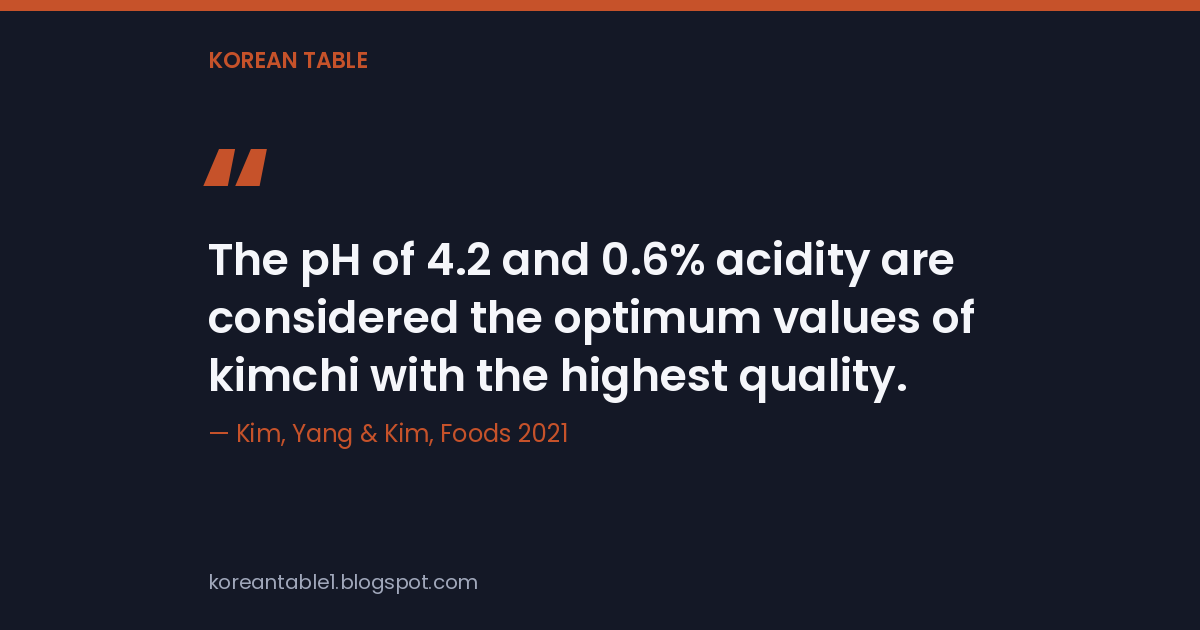
The 2021 paper marks pH 4.2 and 0.6% acidity as the optimum values for kimchi quality. The count peaks at 4°C on day 15, and the paper puts that same sample at about 20 days to reach each of those two values. Past day 20 the jar keeps souring, which Kimchi Too Sour? covers, and a bulging lid is the CO₂ side of the same fermentation, covered in Kimchi Container Bulging?.
None of these four papers has a plate count from a supermarket jar. If anyone has seen one published, with the brand and the manufacture date attached, I would like the citation.
This is a running series, not a one-off post — a new post goes up every day, at around 9am Korea time.
About · Contact · Privacy Policy
Read next: Fish Sauce Substitutes r/fermentation Readers Use in Kimchi · Kimchi Without Fish Sauce: What Replaces the Umami · Why Your Kimchi Isn't Fermenting (It's Probably Not Ruined)


Comments
Post a Comment