Mochi vs Tteok: Why Korean Rice Cake Hardens and Mochi Doesn't
Mochi vs tteok is a fridge question as much as a menu one.
You bought a bag of tteok on Saturday, put it in the fridge the way you would treat any other fresh food, and by Monday the pieces clack against the bowl like plastic. A box of mochi sitting on the same shelf is still soft. Both are rice cakes in English, so the reasonable assumption is that they should behave the same way, and they don't.
The question people type is whether tteok and mochi are the same thing. They start from different rice, and one of those rices carries roughly 18 to 21% amylose while the other has almost none.
Two rices, one English word
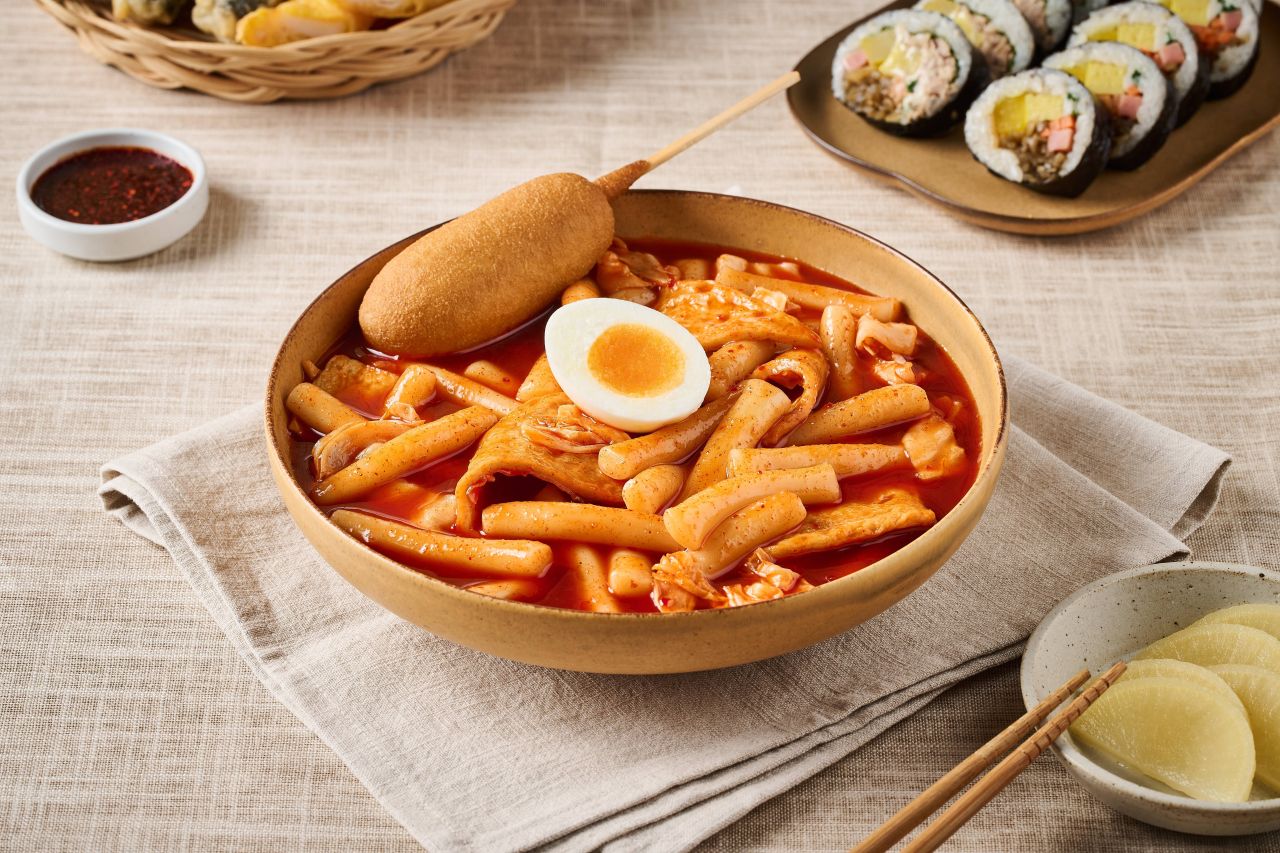
Korean kitchens divide rice into 멥쌀 (mepssal), ordinary non-waxy short-grain rice, and 찹쌀 (chapssal), the glutinous kind. Garaetteok, the cylinders you cut for tteokbokki and slice on the diagonal for tteokguk, is mepssal. A 2023 paper in Foods by Lee and colleagues describes it in one line: "Garaetteok is a long cylindrical rice cake, which is prepared by gelatinizing water and salt in rice flour."
Mochi comes from the other rice. A 2023 study in the International Journal of Molecular Sciences led by Nakano puts the chemistry plainly: "The starch in glutinous rice is composed of α-1,6-branched glucose polymers of amylopectin and lacks α-1,4-linked linear glucose polymers of amylose." The same paper notes that glutinous rice "has an attractive sticky texture and is used for preparing desserts and snacks such as rice cakes and crackers."
Amylose is the component that recrystallizes as a cooked starch cools, so the grain carrying less of it hardens less on the plate. How much less depends on which paper you read, and the two I found don't line up. A 2013 survey of eleven Korean cultivars in the Korean Journal of Crop Science reports that "the amylose content of waxy, middle waxy and non waxy type domestic normal rice cultivars were 7.09%, 11.69% and 18.58-21.52%, respectively." The Japanese group measured 0.5 to 2.1% in their glutinous lines against about 17% in a non-glutinous check variety. That Korean figure is in the abstract; the Japanese one sits in Table 2 of the results, and that paper's abstract says only that the lines "contained essentially no amylose." Neither paper cites the other, and I could not work out from either whether the gap is the cultivars or the assay.

Korea makes cakes from the glutinous rice too. Chapssaltteok, the strawberry-filled ones above, and injeolmi sit in the same starch family as mochi and stay tender for the same reason. So the honest answer to "is tteok mochi" is that some of it nearly is, and the tteok you meet in a tteokbokki pan is another rice entirely. Finding that second kind outside Korea has its own post.
Is tteok the same as mochi?
Some of it is close. Chapssaltteok and injeolmi use glutinous rice, as mochi does. Garaetteok uses non-glutinous mepssal, the ordinary non-waxy kind, and the 2013 Korean survey above puts non-waxy domestic cultivars at 18.58-21.52% amylose.
The fridge is where it goes hard fastest
The Foods team describes the process as one where "an irreversible crystal structure forms through the rearrangement of the side chains of starch, which is called retrogradation." In their storage test the control garaetteok measured about 4,400 g/cm² of hardness at production. After five days at 4°C (39°F) that number was 12,113.6 g/cm².
Refrigerating it is worse than leaving it out. That result surprised me. A 2011 study in the Journal of the Korean Society of Food Culture measured retrogradation in garaetteok by the α-amylase iodine method and reports: "The degrees of Garaetteok retrogradation after 3 days at 4 and 25°C by α-amylase iodine method were 57.44 and 41.55% for control, respectively." Three days in the fridge left the control more retrograded than three days at 25°C (77°F) on a counter.
Korean food writing treats this as known. The Korean food outlet Real Foods put it in one sentence in an April 2024 explainer on why refrigerated tteok and bread taste bad: "이런 전분의 노화는 냉장실의 0~4℃ 온도에서 가장 빠르게 일어난다" — this staling of starch happens fastest at the 0 to 4°C of the refrigerator compartment.
It is also fast in the ordinary sense of the word. A 2007 paper in the Journal of the Korean Society of Food Science and Nutrition by Kim Sang-sook and Chung Hae-young tracked hardness in Karedduk held at 5°C and took its readings at 0, 2, 4, 6, 22, 24, 28 and 30 hours. Their last reading came at 30 hours.

Three days is what the Korean label is built on
Fresh tteok in Korea carries a short date, and there is a document behind it. Asiae reported in January 2023 that under the Ministry of Food and Drug Safety's 소비기한 설정보고서, the food-type use-by reports published for manufacturers, "일반포장한 가래떡의 소비기한은 3일이다" — plainly packaged garaetteok gets three days. The article describes the test behind that figure. Garaetteok in ordinary packaging with no preservative was held at 25°C and 35°C while bacterial counts, E. coli and moisture change were tracked over time.
That three days is a room-temperature figure for a Korean retail pack, not a rule for the frozen import bag in your freezer. Your bag's own printed date is the one that governs. If you want to see the reference values yourself, the Korea Food Industry Association hosts a use-by reference value search and the setting reports as public pages. That page loaded for me on September 21 with 2,037 reference values in it and a 식품군 filter whose first entry is 과자류, 빵류 또는 떡류, the group garaetteok falls under.
For the freezer, Real Foods gives the MFDS recommendation as two months, writing 식약처는 냉동실에서 보관한 떡을 두 달 내 섭취하도록 권장한다.
Freeze it the day you buy it
The same explainer gives the mechanism for why the freezer works where the fridge fails: "영하 18도 이하로 냉동실에 두면 떡에서 수분이 빠져나가기도 전에 얼어 붙어 노화되지 않은 상태가 유지된다." Below −18°C (0°F) the water freezes in place before it can migrate out, and the un-staled state holds.
How cold and how fast both showed up in a 2017 study in the Korean Journal of Food and Cookery Science, which froze sulgitteok and garaetteok at −10°C and −20°C by two methods. Moisture content was higher at −20°C regardless of method, and hardness and chewiness came out lowest with −20°C magnetic-resonance quick freezing. A home freezer sits around −18 to −20°C. That is the cold end of the range they tested.
Reheating undoes the damage, because gelatinizing the starch again takes those crystals apart. Real Foods gives one figure for it, 30 seconds to a minute in the microwave for a frozen piece. I searched in Korean for a Rural Development Administration or MFDS page carrying steaming times for hardened tteok and got retailer blogs, a Q&A site and patent filings, so I have no institutional number for the steamer.
The rule for the bag on your counter comes out short. Cook what you want today at room temperature, portion the rest into freezer bags tonight, and skip the fridge. One thing I can't answer from Korean sources is what the date on an imported pack allows, since the three-day figure is set for Korean retail. What does yours print?
This is a running series, not a one-off post — a new post goes up every day, at around 9am Korea time.
About · Contact · Privacy Policy
Read next: Korean Sweet Potato Types: Bam, Hobak and the Japanese Honey One · Does Gochujang Need to Be Refrigerated After Opening? Yes, Mostly · Kimchi Too Sour? How to Fix It, and What to Cook With It Instead


Comments
Post a Comment