How to Store Rice: Korea's 12-Week Test at 4, 15 and 25°C
White rice "lasts for around two years when stored properly," according to The Takeout's guide to storing uncooked rice. Tasting Table gives two years unopened and one year after opening, and both guides point to a cool, dark pantry or cupboard. Tasting Table adds that white rice can last up to 30 years "but only with very specific storage conditions," meaning food-safe aluminum cans or Mylar bags with oxygen absorbers. It names a temperature only for brown rice.
Korea's Rural Development Administration (RDA, 농촌진흥청) asked a different question in a press release of October 5, 2022, issued by its National Institute of Crop Science: how long the quality of milled rice holds. It followed 2 kg of rice sealed in containers at 4°C (39°F), 15°C (59°F) and 25°C (77°F) for 12 weeks.
The test: 82, 58 and 12 days
The release puts the start of change in taste, freshness and colour at about 82 days at 4°C, 58 days at 15°C and 12 days at 25°C. Its sentence reads "4도에서는 약 82일 후에 밥맛, 신선도, 색이 변하기 시작했으며 15도에서는 58일, 25도에서는 12일 후부터 변화가 시작됐다." Its own subheading rounds the cold result to "about 80 days." The table on the Nongsaro page, the RDA's agricultural portal, breaks that figure into days per reading: gloss (the taste measure) 77, freshness 84 and colour 84 at 4°C; 28, 63 and 84 at 15°C; 14, 14 and 7 at 25°C. The table's own average column reads 82, 58 and 12, which matches the mean of each row (my arithmetic). So the headline numbers are averages, and at 15°C the gloss reading moved after 28 days, not 58.
Per the release, warm storage lets fat in the rice combine with oxygen in the air, which raises acidity, adds a smell and worsens the taste. Taste was scored by a machine reading of how glossy the cooked rice is, freshness by the colour change of a pH indicator, and colour by the b value, a yellowness score. Freshness and colour readings were (7.2, 13.9) at 4°C and (7.1, 13.9) at 15°C; per the release, the two temperatures did not differ once measurement error is allowed for.
The taste score was 78.6 right after milling, 77.1 at 4°C and 72 at 25°C, with no 15°C score in the release text. Nongsaro states the loss in gloss as 1.9% at 4°C, 4.7% at 15°C and 8.4% at 25°C. Those percentages match the scores: 78.6 to 72 is a drop of 8.4%, and 78.6 to 77.1 is 1.9% (my arithmetic).
This is one test, and the release does not name a rice variety. Nor does the Nongsaro page, and the PDF attachment to the release would not download for me. The containers were sealed, and per the release contact with air dries rice and lowers its taste, so an open sack is a case this test did not cover. Twelve weeks is 84 days, the same figure as three cells in that table, and it puts the 4°C average of about 82 days two days before the test ended. For those three readings the test may simply have ended before any change showed (my inference). Neither page says how large the change was on day 12 or whether anyone could taste it.

Reading it for your own kitchen
Separately from its taste numbers, the release says that in a humid summer pests, mold and bacteria can appear, so rice belongs somewhere cool and low in humidity. The two-year claim and the RDA result measure different things. One is how long white rice stays usable, the other is when the readings begin to move, and the release never calls the 25°C rice unusable.
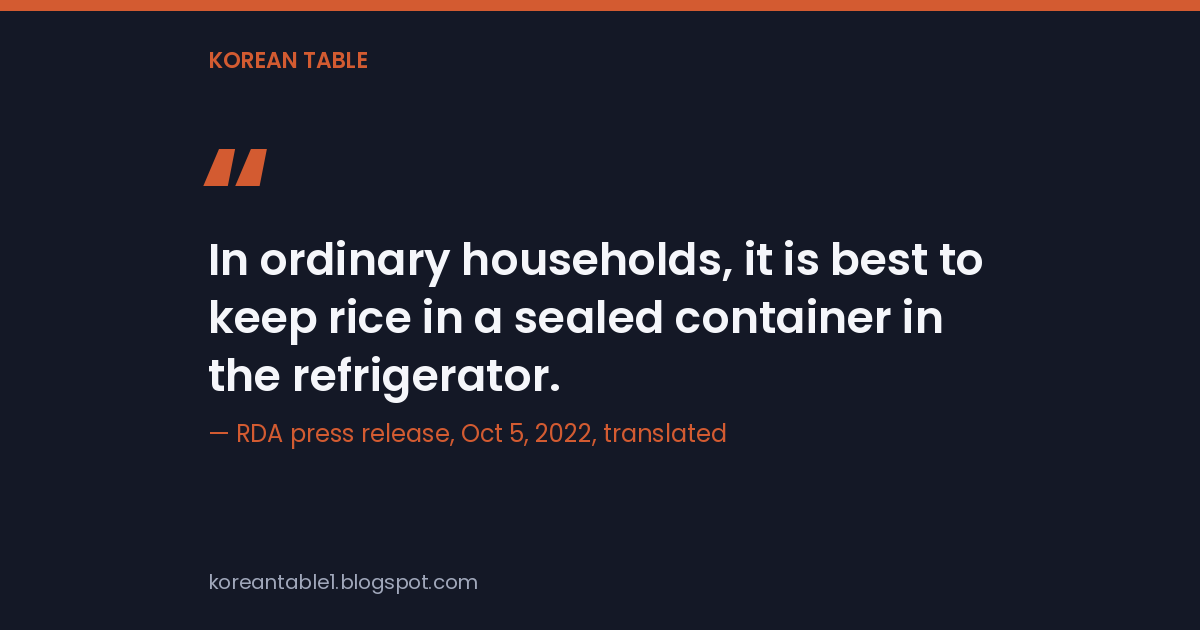
For summer at room temperature, the RDA recommends small bags eaten quickly, and it warns that rice left in sub-zero cold can freeze, swell and crack. If the fridge is not an option, it accepts a cool spot out of direct sun from October to April, when the average temperature is 15°C or below.
Per a footnote in the release, the Korea Meteorological Administration's 1991 to 2020 averages for Seoul run 24.7°C in summer, close to the 25°C test, and 14.7°C in autumn, close to the 15°C one. Those are outdoor figures and no kitchen temperatures are given, so you would need your own thermometer reading to place your rice on this scale. A kitchen near 77°F in July sits beside the 25°C row. Spring averages 12.3°C and winter -0.3°C.
The release also quotes Kim Young, who heads the RDA's Post-Harvest Utilization Division. A survey, which the release does not name, found that most Koreans buy rice every two to three months and keep it at room temperature. That is about 60 to 90 days (my arithmetic). It runs past the 58-day mark at 15°C and several times past the 12-day mark at 25°C.
The National Institute of Crop Science, which issued the test, also has a video on its YouTube channel titled "좋은 국산 쌀 고르고 잘 보관하는 방법" ("How to choose good Korean rice and store it").
The RDA's 78.6 baseline was taken right after milling, and the milling date (도정일자) is a mandatory label item on rice sold in Korea. In its September 21, 2026 release, the Ministry of Agriculture, Food and Rural Affairs lists the required items: item, weight, the producer's address, name and phone, origin, variety, production year, milling date and grade. A false label can bring up to three years in prison or a fine of up to five times the value of the rice, and a missing one an administrative fine of up to 2 million won. The National Agricultural Products Quality Management Service is running a special crackdown on grain fraud, labelling included, from September 28 to November 30 (64 days), timed to the new-crop rice.
Sources: RDA press release, October 5, 2022; RDA Nongsaro page; MAFRA, September 21, 2026; The Takeout; Tasting Table.
This is a running series, not a one-off post — a new post goes up every day, at around 9am Korea time.
About · Contact · Privacy Policy
Read next: Korean Sweet Potato Types: Bam, Hobak and the Japanese Honey One · The 5 mg/L Water Behind CU's New Triangle Kimbap · Korean Rice vs Japanese vs Jasmine: Which Swap Ruins the Dish


Comments
Post a Comment