Why Koreans Call Ottogi 'God-ttugi' and What It Means for Ramen
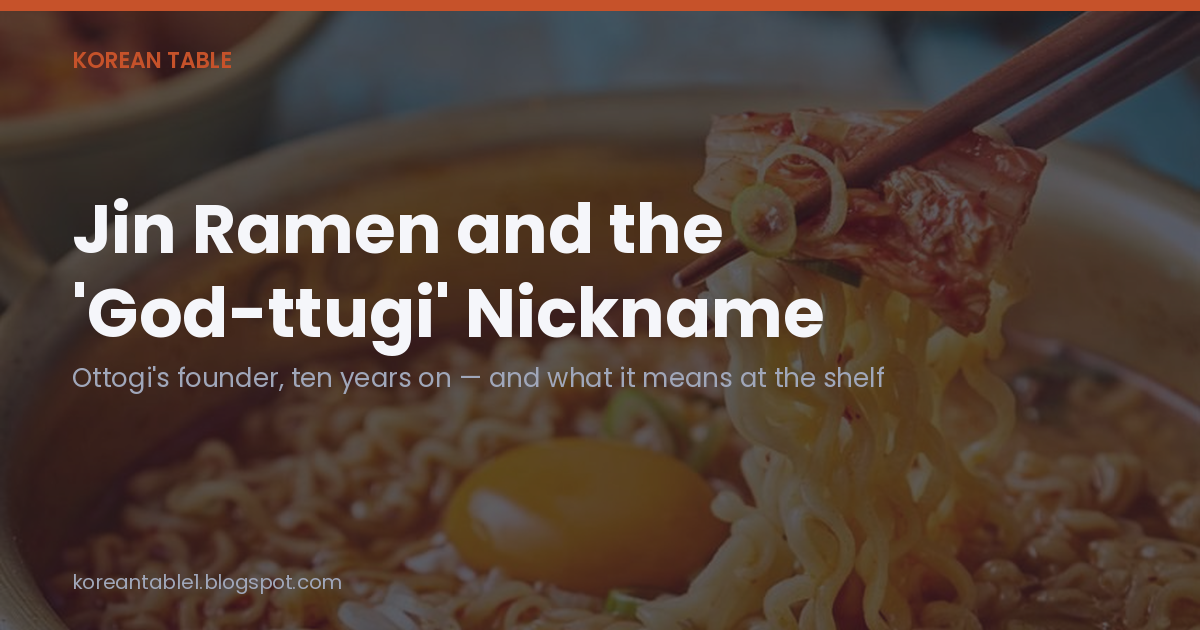
Jin Ramen (진라면) is the Ottogi packet you'll see at H Mart and most Korean grocers, and if you've ever wondered why Korean friends get oddly loyal about it, this week is a good time to explain. On September 11, Ottogi held a memorial in Anyang for its founder, Ham Tae-ho (함태호), ten years after his death. The Korean coverage landed on Monday morning, September 14 KST. I haven't seen it in English yet, which is a shame, because the story behind the packet is the reason a whole country nicknamed the company 갓뚜기, "God-ttugi."
This is a pantry post, not a recipe post. The cooking verdict is near the end.
The memorial, and what the Korean papers said
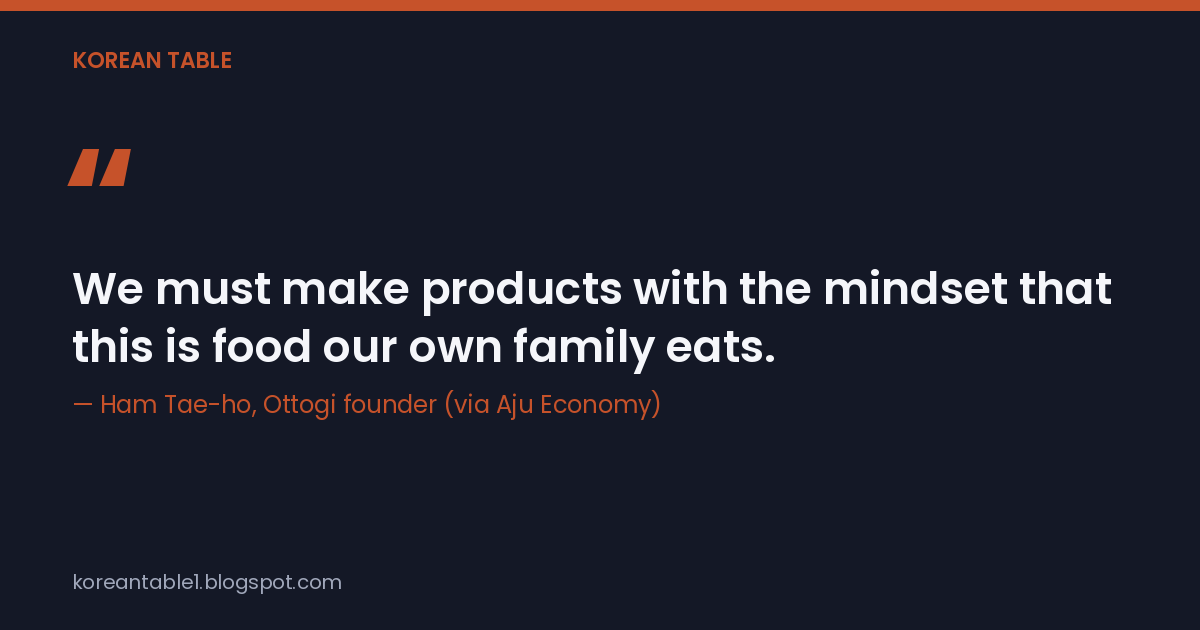
According to Asia Economy's report (Korean, published 09:04 KST on September 14), the memorial took place on the 11th at Hamtaeho Hall (함태호홀) in Anyang, and was meant to revisit the founder's "quality first" principle and his giving. Aju Economy's version, out an hour later, has more detail: the hall is a heritage space Ottogi opened this year inside its Anyang factory, chairman Ham Young-joon (함영준), president Hwang Sung-man and staff attended, and the chairman's line, in my translation, was that "the important task is carrying forward and developing the founder's founding spirit and management philosophy so that Ottogi continues as a sustainable company, whoever leads it." Aju also carries the founder's own rule: "We must make products with the mindset that this is food our own family eats" (우리 가족이 먹는 음식이라는 마음가짐).
The biography both papers repeat is short. Born 1930 in Wonsan, in what is now North Korea. Founded Pungrim Trading (풍림상사), Ottogi's predecessor, in 1969, and launched Ottogi Curry that same year. Started paying for surgery for children with congenital heart disease through the Korean Heart Foundation in 1992, then set up the Ottogi Ham Tae-ho Foundation in 1996. As of August 2026 the surgery program has covered 6,783 children.
He died on September 12, 2016, aged 86, per Kyunghyang Shinmun's obituary, which also credits that 1969 curry as the first produced in Korea (국내 최초).
Where "God-ttugi" came from
The nickname is a mash-up of "God" and Ottogi, and Koreans use it half as a joke, half seriously. The trade magazine The PR traced its origin in a February 2017 piece: it appeared after the founder's death, when good deeds he never publicized got re-reported all at once. The one that hit hardest was a share donation. In November 2015 he gave 30,000 Ottogi shares, worth about ₩31.5 billion (well over $20 million) at that day's close, to the Miral Welfare Foundation, and told nobody. The gift surfaced only because his holdings dropped in a Financial Supervisory Service filing, which Aju Economy reported on November 21, 2015.
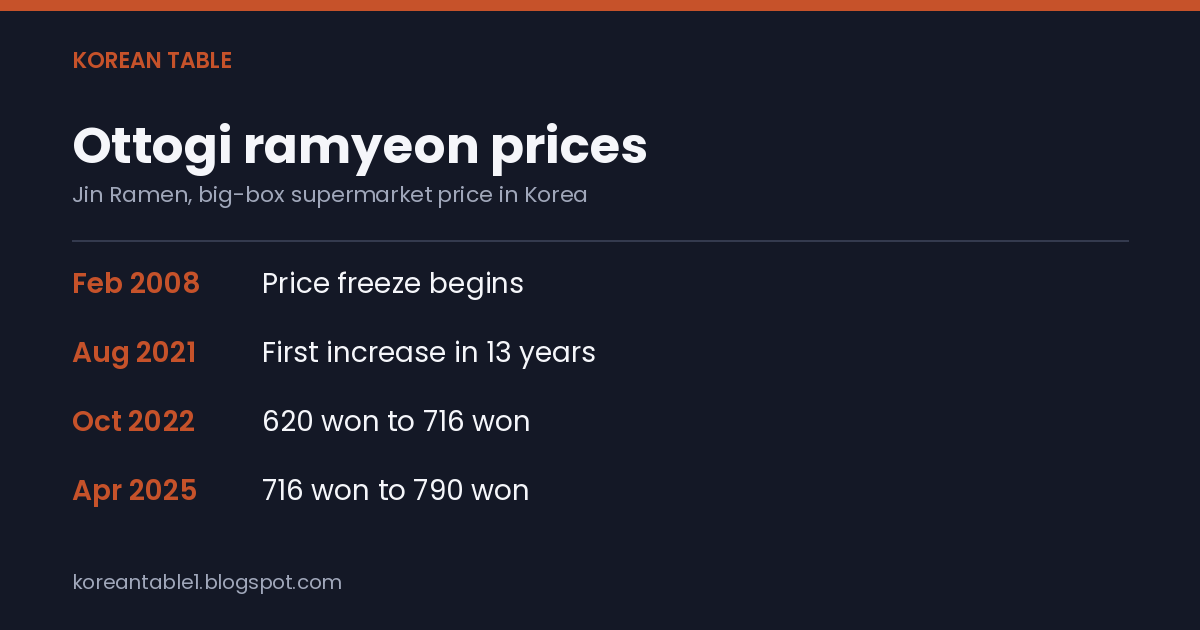
Then came the inheritance. Asia Economy's 2017 rundown of "seven reasons Ottogi became God-ttugi" lists Ham Young-joon, the founder's son, paying roughly ₩150 billion (over $100 million) in inheritance tax on his 13.53% stake, over five years, with no workaround. Same article: 98.84% of the 3,099 employees on regular contracts, only 36 on fixed terms, because the founder's stated rule was "don't hire people as non-regular workers." And the one every home cook noticed: Ottogi had not raised ramyeon prices since February 2008, while Nongshim and Samyang had.
The PR piece describes what happened online next in one sentence I'll translate: people started calling the company God-ttugi and resolving, "if I'm buying ramyeon anyway, let's buy Jin Ramen." That sentence, more than the broth, is why Jin Ramen sits in so many Korean cupboards now.
The price freeze is over, which is worth knowing at the shelf
If you're buying on the "cheap and honest" reputation, update it. Per Business Watch (Korean, September 2022), the first increase after 2008 came in August 2021, thirteen years later. A second followed in October 2022, up 11.0% on average at the factory gate. Jin Ramen went from ₩620 to ₩716 at big-box supermarkets, a 15.5% jump. Even then, the same article counted Ottogi at two increases since 2008 against four each for Nongshim and Paldo. The third came on April 1, 2025: ₩716 to ₩790, 10.3%, which Kyunghyang reported with the company blaming palm oil, the exchange rate and logistics.
So the packet is still cheap in Korea, and the gap to the competition has narrowed. Abroad the pricing is whatever the importer decides. H Mart's Manhattan delivery site listed the Jin Ramen Spicy 4-pack (480 g) at $7.79, marked down to $6.23, when I checked on September 14. Call it $1.55 to $1.95 a packet, about three times the Korean shelf price.
Mild or spicy, and does the "good company" story make it taste better?
No. Broth is broth. But there's a real choice on the shelf that the English packaging undersells.
Jin Ramen launched in 1988 in two versions at once, 순한맛 (mild) and 매운맛 (spicy), in a market where nearly everything was spicy, and Koreans argue about the two online to this day. When the food trade paper Daily CNC covered the "진순파 vs 진매파" (Team Mild vs Team Spicy) fight in January 2022, it cited an online poll (November 12 to December 9) of 21,070 for spicy against 15,993 for mild. Each side calls the other 맛알못, "people who don't know taste." Ottogi also reformulated Jin Ramen on September 9, 2024: over 10% more dried toppings, a chewier noodle, a stronger beef-brisket stock and a higher spice level, per the company's own release (Korean, an October 2024 ad announcement that recaps the change). If your last packet was pre-2024, the new one is hotter.
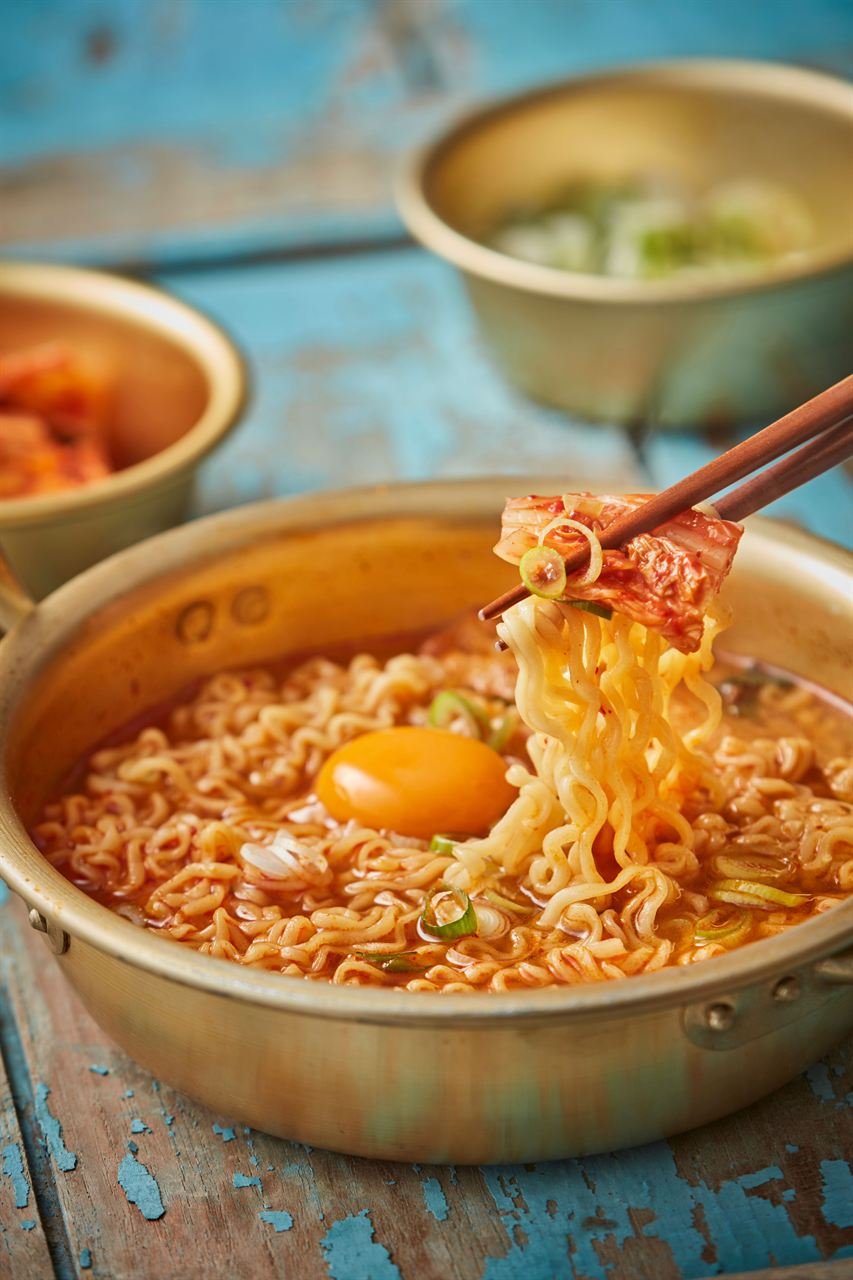
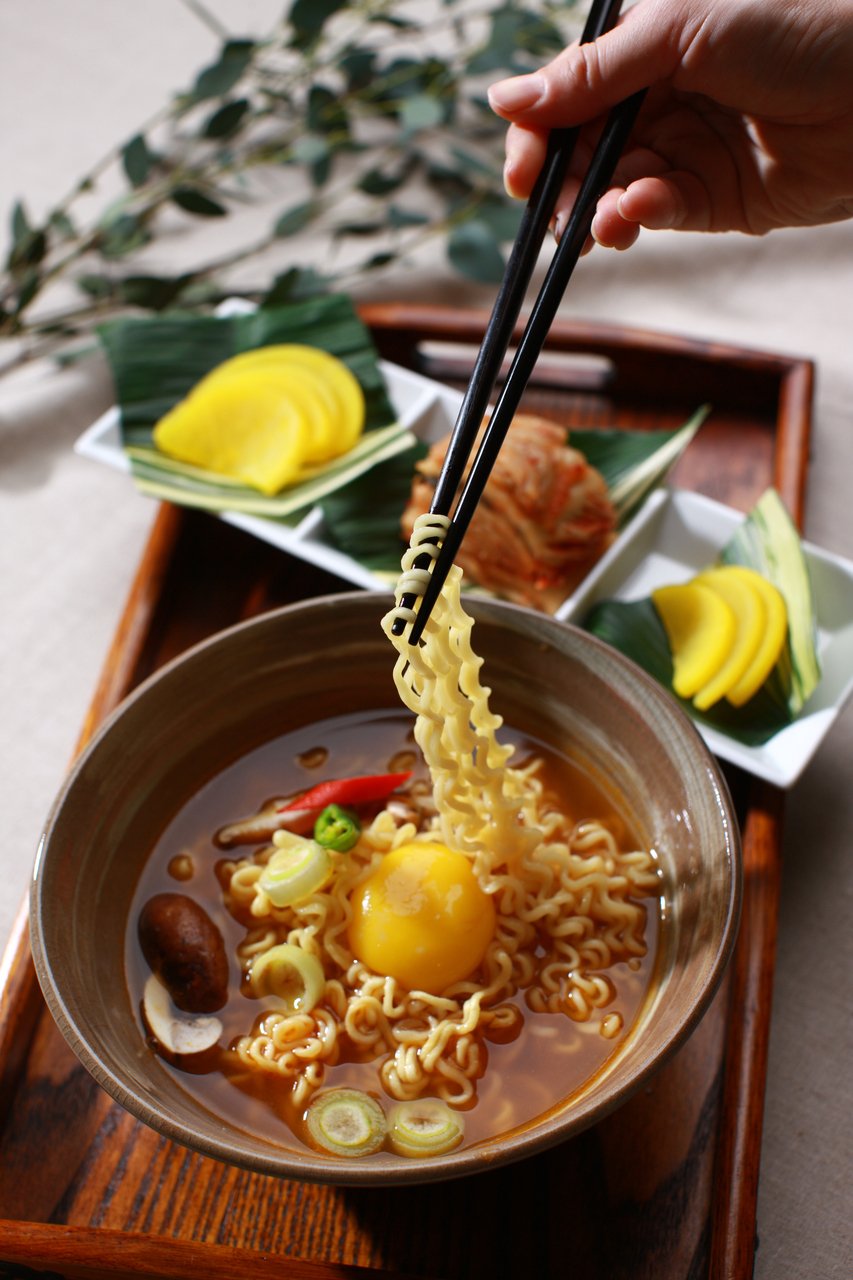
My cooking take, for what it's worth: buy the mild one for anything you'll add things to. It's the lighter broth of the two, and it takes an egg, a handful of kimchi and a slice of American cheese without turning heavy. Cheese in a chili-heavy broth drags the whole bowl down; in the mild one it just rounds it out. Buy the spicy one when you want the packet as-is. Either way, measure the water. Ottogi's instructions call for 500 ml per packet, 50 ml less than Shin Ramyun's 550, as a January 2025 retail column by The Fact, on Daum News (Korean) spells out. My guess is that missing 50 ml is a good part of what makes the broth "진한" (jin-han, the "deep, rich" the name refers to). Don't eyeball it.
What Koreans say now, ten years on
I opened three community threads so you don't have to, and the mood has shifted. A 2018 Clien thread titled, in loose translation, "You keep saying God-ttugi, but do you know why?" still ran mostly warm: the price freeze, the heart-surgery program, one commenter whose sister had surgery paid for in 1998. The minority said the people who work there call it 헬뚜기, "Hell-ttugi" (one commenter: "a friend who works at Ottogi curses it out constantly"). A 2021 Clien thread, "God-ttugi's betrayal," was about a supplier allegedly passing off Chinese-origin laver as Korean in Ottogi-branded seaweed for about a decade. Comments split about 60/40 between those saying Ottogi was the one deceived, by one of its three suppliers, and those saying, as one put it, "if it went on for over ten years, Ottogi can hardly escape responsibility either." By a May 2024 FM Korea thread on employee treatment, 309 comments and mostly sour, the joke had inverted. Two lines that sum it up, translated loosely: "Ottogi pushed the 'good company' PR way too hard," and "low-margin industries are all like this."
That's the honest picture. The founder's record is documented and real. The company that survives him is a normal Korean food company with better-than-average labor numbers, a decent cheap packet, and a nickname it's now slightly stuck with.
Store the packets somewhere cool and dark, and if you've tried both, tell me which team you're on. I'm 진순파.
This is a running news series, not a one-off post — new stories go up twice a day, roughly 7am and 7pm Korea time.
More Korea coverage from our network: Hallyu Now · Korea Travel Planner · K-Sports Global · Seoul Skin Notes


Comments
Post a Comment