How to Read the Date on Korean Food Packages After the 2023 Law Change
Does gochujang go bad? Before answering that, one change comes first. Korean law replaced the term printed on food packages, effective January 1, 2023.
Korean food packages used to show a 유통기한 (yutonggihan), a "distribution date" set for retailers. The law now requires a 소비기한 (sobigihan) instead, a "consumption date." Article 2(12) of the Food Labeling and Advertising Act, as summarized by Korea's own Ministry of Government Legislation, defines it as the period during which a food stays safe to eat if the storage method printed on the label was followed. A store's old sell-by window measured something else: how long the retailer could keep stock on a shelf. The switch covers anything manufactured, processed, or shipped for import from January 1, 2023, per the law's own supplementary clause (Act No. 18445, promulgated August 17, 2021, Article 2). Manufacturers got a one-year grace period to sell through old-style packaging; nothing made after 2023 is allowed to skip the new term.
The Government's Own Math
"Consumption date" reads like the stricter cutoff. People expect a shorter number than the old distribution date carried. The formula behind it runs the other way.
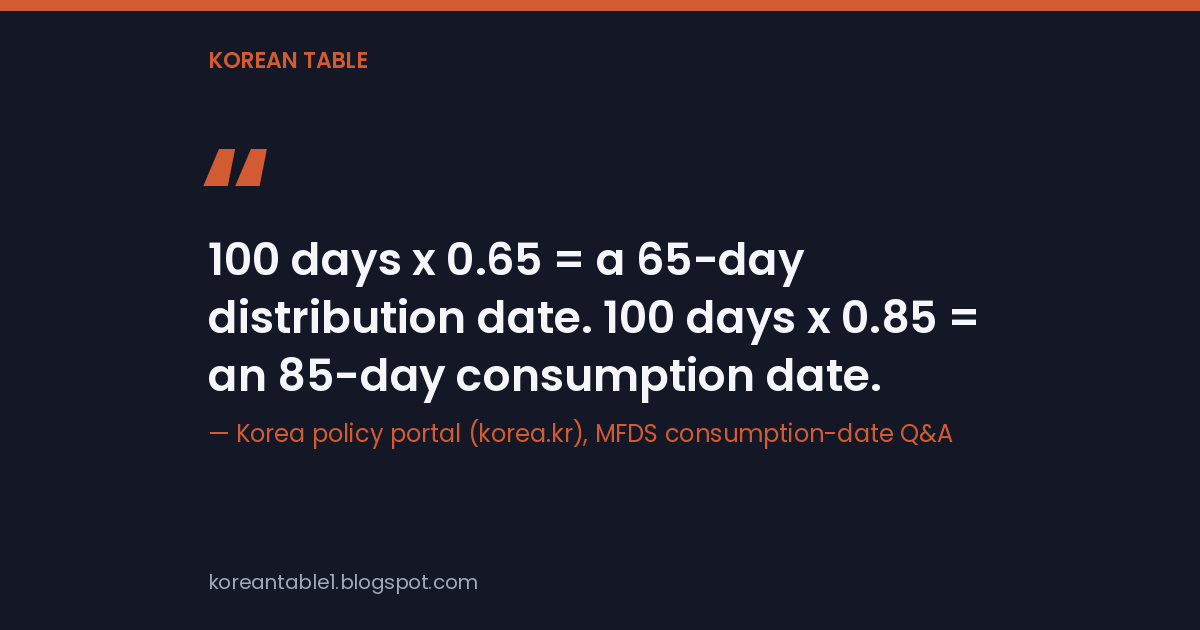
Manufacturers first test how long a food holds up in storage and find a 품질안전한계기간, a "quality-safety limit period," the point where some tracked measure first starts to change. They multiply that period by a safety factor under 1.0. A distribution date uses 0.6 to 0.7 of the limit period. A consumption date uses 0.8 to 0.9. Korea's policy portal walks through the arithmetic with a plain example. A 70-day limit period at a 0.77 factor comes out to 53.9 days, rounded down to a 53-day consumption date. A second example from the same source makes the comparison cleaner. Take a single 100-day limit period. At a 0.65 factor, that's a 65-day distribution date. At a 0.85 factor, that same 100-day test result becomes an 85-day consumption date.
The Ministry of Food and Drug Safety (MFDS) published its own before-and-after table for ten everyday food types, and the pattern holds across all ten. Processed milk went from 16 days to 24. Tofu went from 17 to 23. Fermented yogurt drinks went from 18 to 32. Bread went from 20 to 31. Sausage went from 39 to 56. Fish cake went from 29 to 42. Lactic-acid-bacteria drinks went from 18 to 26. Pressed ham went from 43 to 66. Regular ham went from 38 to 57. Tofu's jump is the smallest of the ten at 35%. Fermented yogurt drinks gained the most, 78%.
Where Instant Noodles and Fish Cake Fit
Eight months into the new system, on August 2, 2023, MFDS added a batch covering 39 food types and 120 products, reported the same day by Nongmin Ilbo. This is where instant ramyeon shows up, under its regulatory category name, 유탕면 ("fried noodles"). MFDS reset the date for eight fried-noodle products, from a 92-to-183-day distribution window to a 104-to-291-day consumption window, nearly double at the top end. Seven braised side-dish products (조림류) moved from 3-to-14 days to 4-to-21 days. That's a separate figure from the sodium content printed in a ramyeon packet's nutrition panel, which sits elsewhere on the package and counts milligrams instead of days. By that August release, MFDS had published reference values for 51 food types and 550 products total, working through roughly 200 food categories it expects to finish testing by 2025.
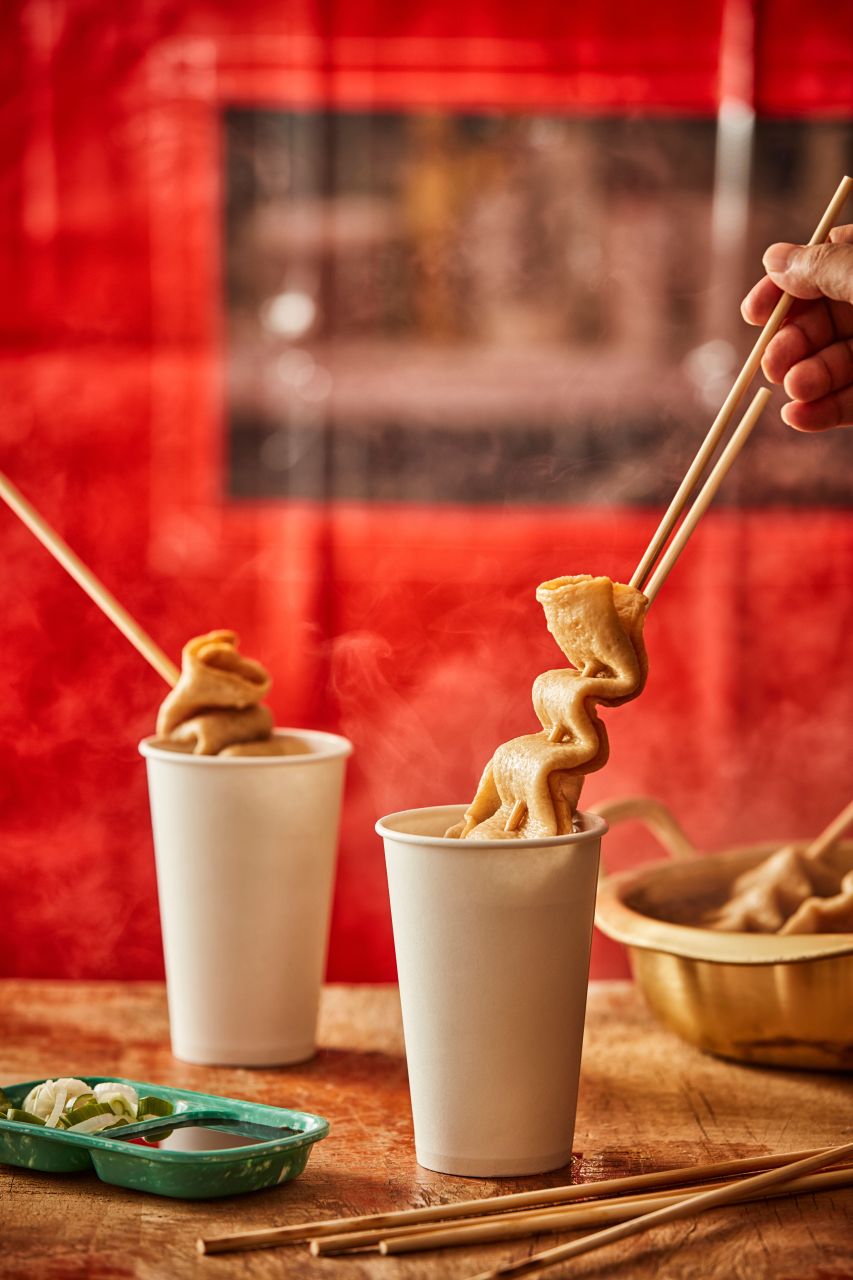
Packaged fish cake sits inside the reference figure above, 29 days to 42. A skewer bought hot off a street cart has no printed date on it at all.
Milk Still Runs on the Old Rule
One category was carved out on purpose. Plain white milk, the refrigerated kind covered under the Livestock Products Sanitary Control Act's own dairy notice, doesn't switch to a consumption date until January 1, 2031. That date comes from the enforcement rule's own supplementary clause (Rule No. 1813, June 30, 2022, Article 2(2)). The stated reason is giving Korea's cold-chain refrigeration standards time to catch up before a genuinely fragile product gets a longer date on the label. Flavored milk, fortified milk, chocolate milk, and other processed dairy already switched in 2023 along with everything else. A carton of plain 흰우유 and a bottle of banana milk sitting next to it in a Korean fridge case are legal with two different kinds of date printed on them right now. Both are correct.
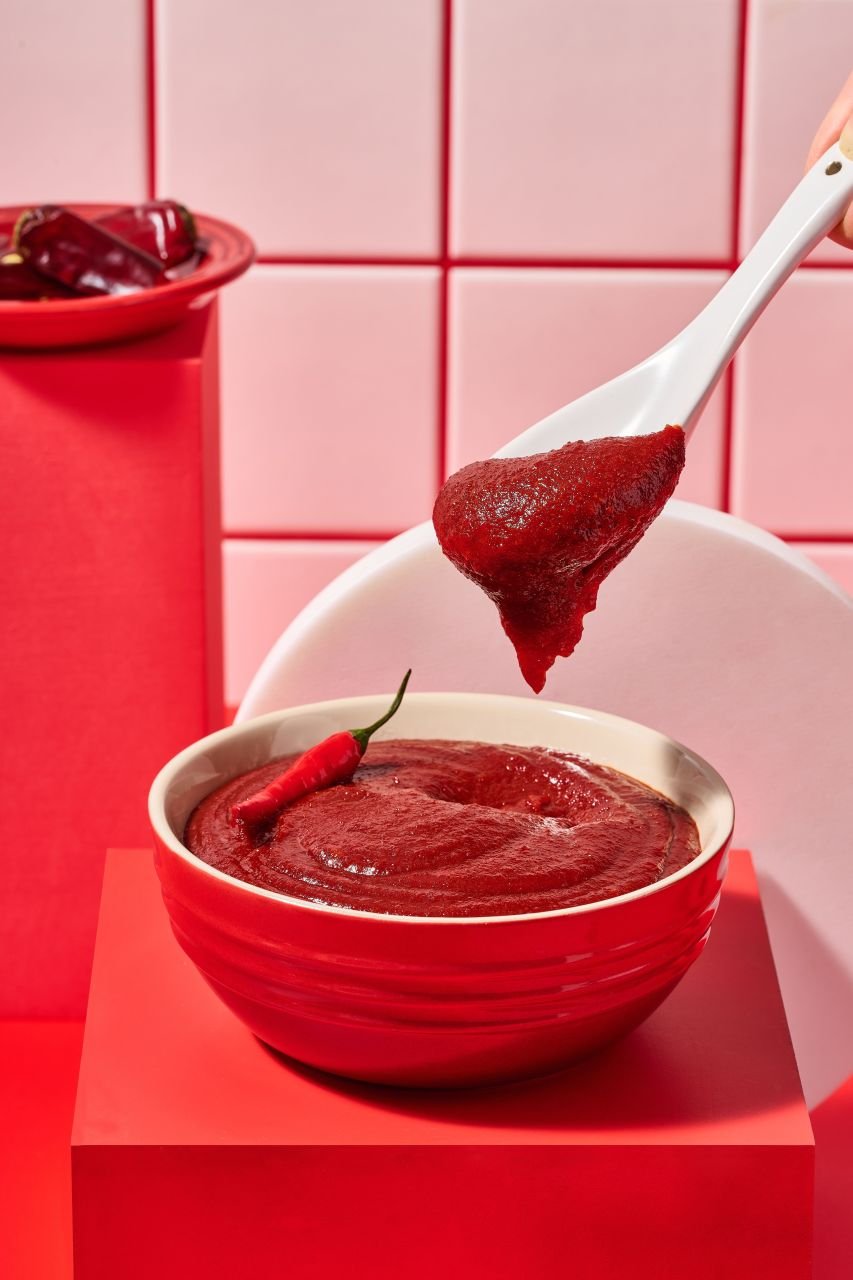
I searched in Korean for "고추장 소비기한 참고값" and "장류 소비기한" specifically, since gochujang is what sent me looking into this in the first place. None of the ministry pages or news coverage I could open list a published reference value for gochujang, doenjang, or jang-ryu (fermented pastes) as a category. The released tables I found cover dairy, bread, processed meat, fish cake, and instant noodles. Fermented pastes aren't on them yet. I couldn't close that gap; I'm not withholding a number I found.
Public recognition of the switch is still catching up to the law itself. An April 2025 piece by MFDS's own food-labeling policy director, Lee Ho-dong, put awareness of the consumption-date system at 53.4% at the end of 2022. By the end of 2024, that had risen to 85.4%, still not full coverage two years after the mandatory switch.
None of this hands over gochujang's exact number. Whatever that number eventually turns out to be, it will already be a safety-margin figure, with the cushion an old-style distribution date never had built into it. The old habit of tacking a few "just in case" extra months onto a distribution date doesn't fit a term that already has that cushion inside the number itself.
What's the date printed on the last Korean product you bought outside Korea, and which of the two Korean words was sitting next to it?
This is a running series, not a one-off post — a new post goes up every day, at around 9am Korea time.
About · Contact · Privacy Policy
Read next: Why a Seoul Michelin Restaurant Just Paid 25 Million Won in Fines · Are Korean Side Dishes Free? Banchan Refills and the Reuse Law · Ssamjang vs Gochujang: The Korean BBQ Sauce Mix-Up
You might also like: How Korea Defines a Niacinamide Whitening Serum (2-5%) (Seoul Skin Notes) · Why Korean Sunscreen Isn't FDA-Approved in 2026 (Seoul Skin Notes) · "Dermatologist Tested" vs "Doctor Recommended" on Korean Labels (Seoul Skin Notes)


Comments
Post a Comment