How Much Sodium Is in Korean Ramyeon, Packet by Packet
The Korea Consumer Agency put twelve packets of ramyeon through a lab in 2014. Sodium ran from 1,350 to 2,069 mg per packet, a 1.5x gap between the saltiest and the mildest on the same shelf.
I have not tested a packet myself. Everything below is Korean test data or label data with the year attached to every figure, because recipes get reformulated and several of these numbers moved between 2007 and 2019.
The 2014 test, and where 86.5% comes from
The Korea Consumer Agency test, reported by the government's policy briefing service on October 15, 2014, covered twelve packets of ramyeon from Nongshim, Ottogi, Samyang Foods and Paldo. Shin Ramyun, Ansungtangmyun, Jin Ramen Spicy, Neoguri Udon (spicy) and Kkokkomyeon were among them. The policy briefing ran it under a headline putting one packet at 87% of the daily sodium reference.
Sodium averaged 1,729 mg per packet. Korea's daily reference value for sodium is 2,000 mg, so one packet covered 86.5% of a day. Saturated fat averaged 7.7 g against a 15 g reference, running from 6.3 to 9.1 g across the twelve, a spread of about 1.4x.
Those figures are per packet, counting everything the packet holds. What none of the coverage sets out is how the agency prepared the samples, so read them as packet totals rather than as what ends up in you.
The industry had already been through several rounds of reduction by then. The Korea Food and Drug Administration said in an August 2011 briefing that Korean ramyeon at a serving size of 100 g or more sat at 90 to 130% of the World Health Organization's 2,000 mg daily recommended intake, and that two or three industry-wide rounds since 2005 had already taken sodium down by 12 to 15%. A further 4 to 15% was set for the rest of 2011, with another 3 to 5% for 2012.

Most of it is in the broth
Five years later the agency ran the test again, on twelve instant dried-noodle products (건면, the non-fried kind) from five makers. Edaily's write-up of the December 23, 2019 release puts average sodium at 1,725 mg, 86% of the daily reference, almost level with the 1,729 mg of the fried packets five years earlier. Calories and fat were where the two diverged, 382 kcal against 505 kcal and 3 g of fat against 17 g.
The agency also measured where that sodium sat. In the release's words as Edaily quotes them, translated, "72% of total sodium content (1,242 mg) is contained in the broth, so eating mainly the noodles (including the dried vegetable flakes) or reducing the amount of soup powder added during cooking can reduce sodium intake."
The same test held the labels up against the lab results, and two products missed. MBC's report, filed at 12:08 on the day of the release, named Nongshim's Myeolchi Kalguksu, which measured 2.5 times the fat its label declared, and Samyang Foods' Bajirak Kalguksu, which came in 29% above its stated calories. Neither product is a fried packet ramyeon, and neither miss was on sodium.
Professor Oh Chang-hwan's group at Semyung University cooked instant ramyeon three ways and analysed the sodium in each, published in the Korean Journal of Food and Cookery Science and reported by Edaily on December 17, 2018. Their two-pot method used 550 mL of water in each of two pots, noodles in one and the soup and vegetable sachets in the other, four minutes of boiling, then the noodles lifted across and heated 30 seconds more. Standard cooking gave 1,890.5 mg across noodles and broth. The two-pot version came out at 1,645.3 mg, 87% of standard, and the paper says eating only the noodles from that version drops intake to 73%.
Their milk version, 450 mL of water plus 100 mL of milk, measured 2,012.2 mg, above standard. The team attributed that to sodium in the milk.
Two further claims in the same Edaily piece carry no citation I could follow, so treat them as the reporter's background rather than as tested figures. One is that only about 20% of a packet's sodium sits in the noodles before cooking, with the rest soaking in from the broth as it cooks. The other is that blanching the noodles, discarding that water and boiling the ramyeon again has been found to cut fat by 56%, saturated fat by 60% and sodium by a further 40%.
Brand numbers, with a year on them
In March 2013, Food Today published a six-year comparison of sodium per serving across the four big makers.
| Product | 2007 | 2012 |
|---|---|---|
| Shin Ramyun (Nongshim) | 1,930 mg | 1,930 mg |
| Ansungtangmyun (Nongshim) | 1,890 mg | 1,790 mg |
| Samyang Ramen (Samyang) | 2,250 mg | 1,960 mg |
| Wangttukkeong (Paldo) | 2,500 mg | 1,890 mg |
| Kimchi Wangttukkeong (Paldo) | 2,600 mg | 1,930 mg |
| Cup Samyang Ramen (Samyang) | 1,850 mg | 1,220 mg |
Shin Ramyun was the one line that did not move, 1,930 mg in 2007 and 1,930 mg as of 2012 in the article's own words, while the rest of the industry came down. A Nongshim official quoted in the same piece said the company was reducing sodium in stages while holding the flavour, and that Shin Ramyun was planned to go under 1,650 mg by 2015.
Ottogi's two Jin Ramen variants sit in the same comparison, with Spicy going 1,940 to 1,880 mg and Mild 1,990 to 1,900 mg. A further reduction in January 2013 left Spicy at 1,860 mg and Mild at 1,880 mg. The mild one carries the higher number.
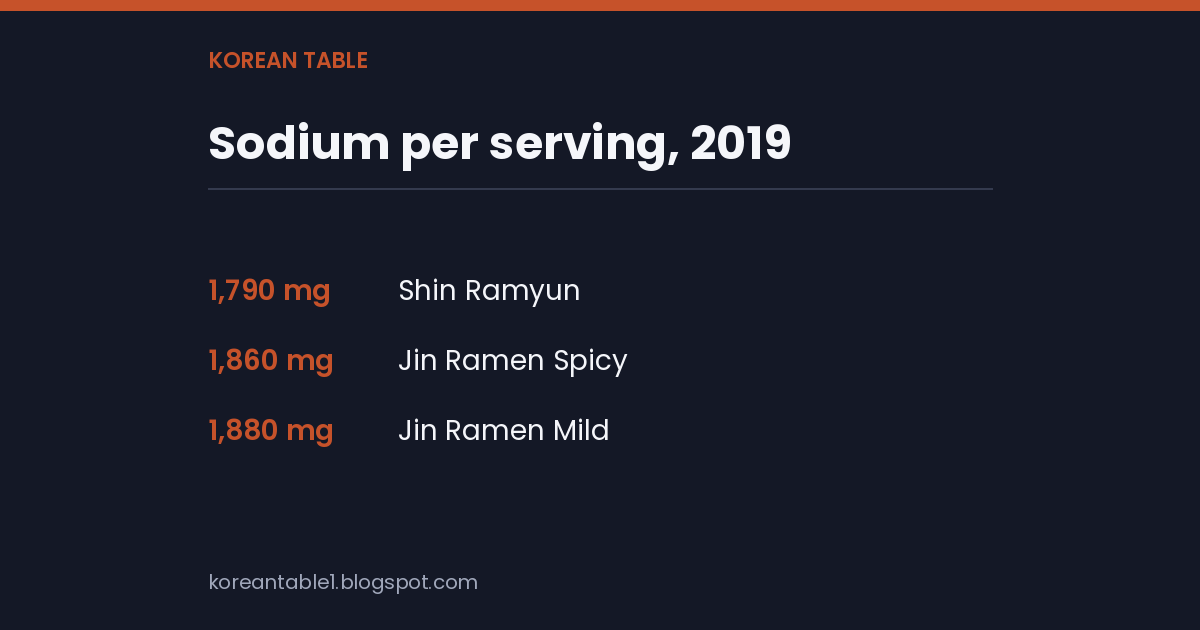
Six years on, Insight read both companies' own websites in January 2019 and got Shin Ramyun 1,790 mg, Jin Ramen Spicy 1,860 mg, Jin Ramen Mild 1,880 mg. The inversion held.
The store-brand result
Ministry of Food and Drug Safety data given to lawmaker Sung Il-jong's office, reported by Food Journal on October 11, 2017, covered 284 ramyeon items, 120 of them, or 42% of the list, private-brand products sold under a retailer's own name. The private-brand average was 1,401 mg against 1,306 mg for the rest. The single highest item was Gonghwachun Samseon Jjamppong Cup at 2,340 mg. Of the 25 saltiest items, averaging 2,047 mg, 92% were private brands.
Those averages run across cups and packets of different sizes. The per-packet numbers higher up this post came from a different test on a fixed packet basis, so the two sets are not directly comparable.
What to check on your own packet
Nongshim publishes the US label for Shin Ramyun Noodle Soup, a 4.2 oz (120 g) packet. On that Nutrition Facts panel a serving is 2 oz (56 g), a container holds about 2 servings, and sodium is 1,050 mg, 44% Daily Value. By the panel's own count of two servings the packet comes to roughly 2,100 mg. Nongshim does not print that total anywhere on the page, so the multiplication is mine.
The 1,790 mg that Insight read off Nongshim's own Korean site in 2019 and the US panel's numbers do not agree, and I could not find a Nongshim statement about why.
For a Korean figure on a specific product, the Ministry of Food and Drug Safety runs a public nutrition database at various.foodsafetykorea.go.kr/nutrient. It is Korean-language only and matches on Korean product names, so paste 신라면 or 진라면 into the search box. Outside Korea, read the panel printed on the packet you bought. Its per container figure is what lines up with the Korean per packet numbers, and the per serving figure will be smaller by however many servings the panel declares.
The number that bears on dinner is 1,242 of 1,725 mg, measured on the dried-noodle set in 2019.
What number is on your packet, and which country was that label printed for? I am curious how far the export labels drift from the Korean ones.
This is a running series, not a one-off post — a new post goes up every day, at around 9am Korea time.
About · Contact · Privacy Policy
Read next: What to Add to Ramyeon: Cheese, Egg or Mandu, Tested · Why Koreans Call Ottogi 'God-ttugi' and What It Means for Ramen · How to Read the Date on Korean Food Packages After the 2023 Law Change


Comments
Post a Comment