Why Your Kimchi Isn't Fermenting (It's Probably Not Ruined)
Your kimchi isn't fermenting, or so it looks. No hiss, no bubbles, nothing, three days after you packed the jar. A silent lid is almost never the actual problem. It's usually just the wrong thing to be watching.
Three things genuinely control whether a batch ferments — how much salt is in it, how warm the room is, and how you're reading the jar. Get those three right and the fizz shows up on its own schedule, and not yours.
No Bubbles Doesn't Mean Nothing's Happening
A plain screw-top jar and a fermentation crock with an airlock don't behave the same way, and that difference alone explains most of the panic. Brine & Bubble puts it plainly and writes: "In a sealed jar like a mason jar with a standard lid, gas builds up between the lid and the brine and simply seeps out without any visible activity at the surface." An airlock forces that same gas through water, so you see it. A regular lid just lets it go without a sound.
Early fermentation is also weaker than people expect. The same guide notes that "fermentation does not always produce big, dramatic bubbles. In the early stages, CO2 can escape so slowly that you miss it entirely." An empty-looking jar isn't proof of anything. It's just a jar with a lid that doesn't tattle.
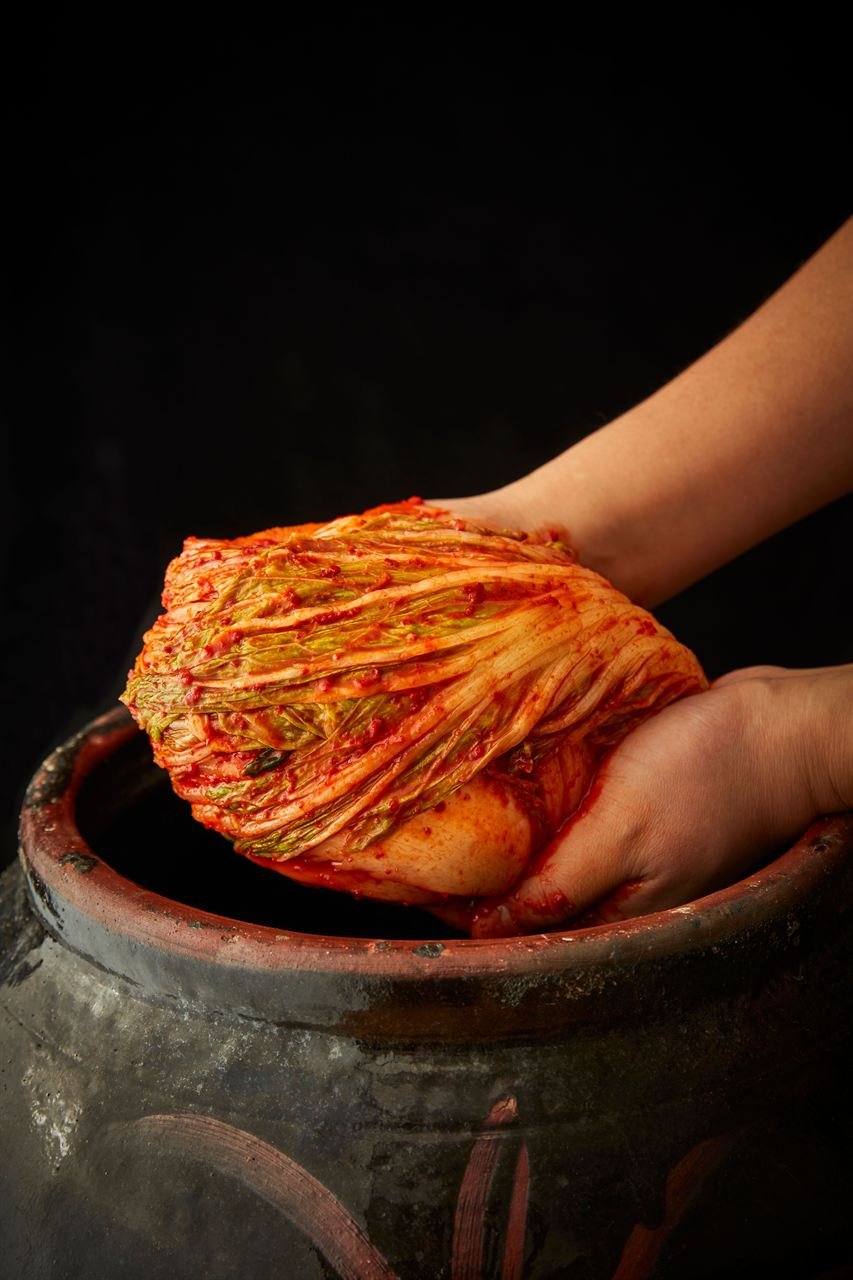
So what should you check? Smell, mostly. Brine & Bubble calls out "a pleasantly sour, tangy, or slightly funky smell, even a mild one" as the reliable signal, along with a faint hiss when you crack the lid and tiny bubbles clinging to the cabbage near the bottom of the jar. Taste is the tiebreaker once you're a few days in. A screw-top mason jar works fine for kimchi. You're just trading away the one visual cue an airlock would have given you, and not the fermentation itself.
Salt Is Doing Chemistry, Not Just Seasoning
Two very different salt numbers get lumped together, and mixing them up is where a lot of "why isn't this working" starts. The first is the heavy salting that wilts the raw cabbage before anything else happens. Brine Calculators puts a traditional napa salting at around 4.3% by weight (roughly 60 g of coarse salt to 1.4 kg of cabbage), and nearly all of that gets rinsed off again before the paste goes on.
The number that actually governs fermentation is the finished dish's salt content, and it's much lower: 1.5% to 3% by weight, with 2% called "the sweet spot," per the same source. Too little, and there isn't enough salt to hold back spoilage organisms while the lactic acid bacteria get established. Brine Calculators is direct and says: "using too little salt risks spoilage." Too much, and it does the opposite job too well, suppressing the fermentation you're trying to get. And salt doesn't fade with time. "Salt levels don't decrease during fermentation — if it's salty on day one, it will remain salty," so a paste that tastes right when you mix it stays right, and a paste that tastes over-salted at hour zero won't mellow into anything else.
If your paste leans light on salt, that's usually the fish sauce or salted shrimp (aekjeot or saeujeot, sold at any Korean grocery or H Mart) doing double duty. They carry both flavor and a chunk of the salt total, so cutting them for a milder taste quietly cuts your safety margin too.

Temperature Sets the Clock
The University of Georgia's Cooperative Extension lays out a specific timeline: kimchi loosely covered and left at room temperature for the first 48 hours, then moved to the refrigerator at 41°F (5°C) or below. Visible bubbling, when it does show, "typically" shows up "within the first 1 to 2 days at room temperature." Full, safely sour kimchi (a pH under 4.6) takes roughly two weeks to get there.
That 48-hour window assumes something close to a standard 68–75°F (20–24°C) kitchen. A cold apartment running closer to 60°F slows the bacteria down without stopping them, so give a sluggish batch an extra day or two on the counter before you decide it's stuck, rather than moving it to the fridge on the recipe's schedule and locking in a half-fermented jar for weeks.

The Difference Between Sour and Spoiled
Real failure has a specific look, and it isn't "quiet." Fermented Food Lab is blunt about the mechanism — mold "can form when the ferment is exposed to air," and that's why keeping every scrap of cabbage pressed under its own brine matters more than any other single step. A stray leaf poking above the liquid is the one that turns fuzzy first.
The same source gives clear thresholds for what to do about it. Small mold on a piece sticking out of the brine — toss that piece, the rest is fine. A third or more of the surface covered — "throw the whole thing away." Mold showing up inside the jar rather than just on top — "don't eat it. Something is wrong with it," full stop, no salvage attempt. Sour, funky, a little fizzy on the tongue is the destination you're fermenting toward, and not a warning sign. A smell that's rotten instead of sour, or real fuzzy growth, is the one time to stop.
Give a new batch its full 48 hours before you start worrying, keep the cabbage pushed down under its own juice, and trust your nose over an empty-looking lid. Most kimchi that gets written off as "not fermenting" was fermenting the entire time — it just hadn't found a way to tell you yet.
This is a running news series, not a one-off post — new stories go up twice a day, roughly 7am and 7pm Korea time.
More Korea coverage from our network: Hallyu Now · Korea Travel Planner · K-Sports Global · Seoul Skin Notes


Comments
Post a Comment