Is Kimchi Too Salty? 593 mg of Sodium per 100 g
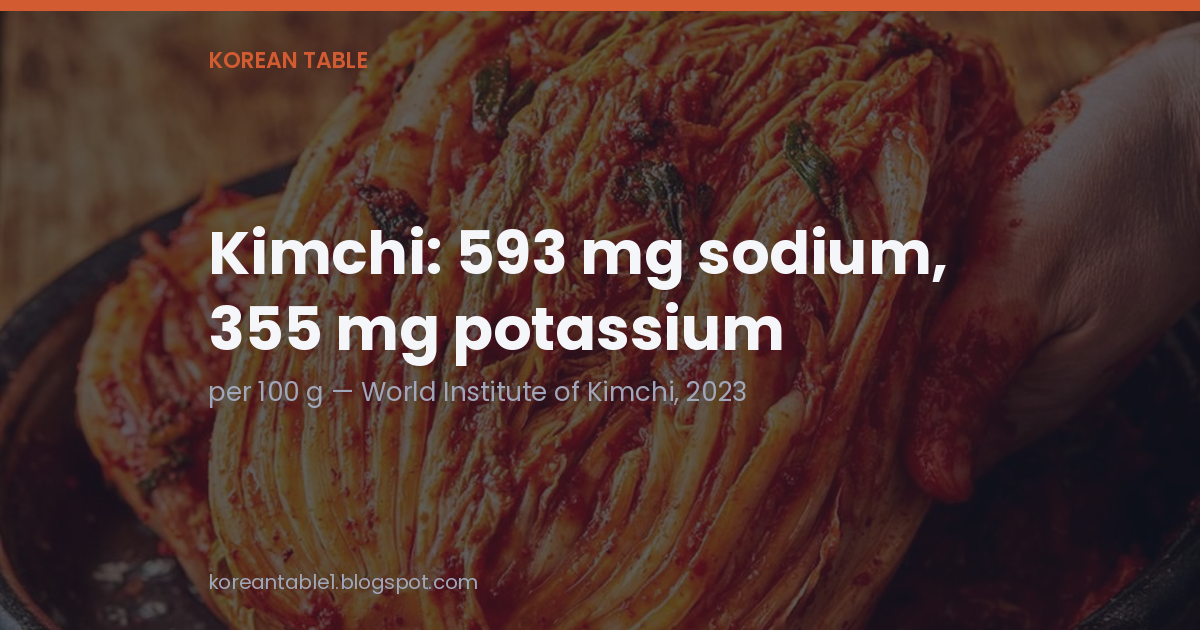
How much sodium is in kimchi? 593 mg per 100 g. The figure comes from the World Institute of Kimchi (세계김치연구소), the government-funded research institute in Gwangju, and it is the number quoted whenever kimchi gets called a salt bomb.
The same page prints a second number right beside it. Potassium, 355 mg.
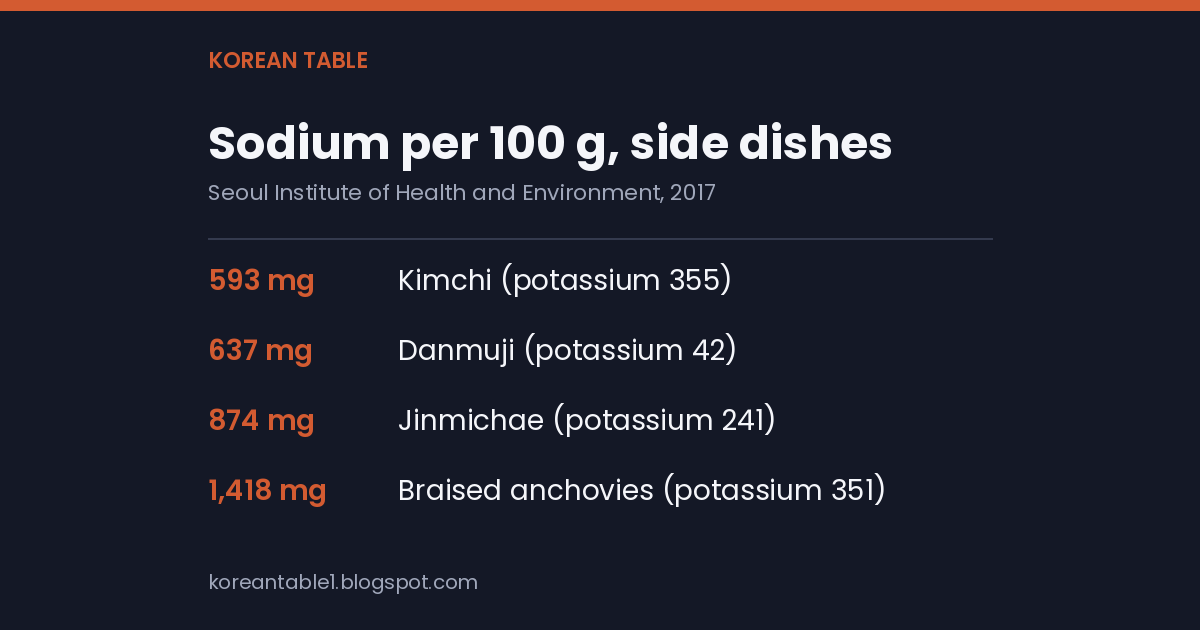
That pairing is the whole argument, and the institute makes it explicitly. Its fact-check card news on kimchi sodium, dated 10 February 2023, sets kimchi's potassium-to-sodium ratio at 1 to 1.7 and puts danmuji, the yellow pickled radish that comes free with your jjajangmyeon, in the row below. Danmuji runs 637 mg of sodium against 42 mg of potassium, so 1 to 15.2.
Where 593 mg sits inside a Korean day
Those two numbers are not from a national food-composition table. I had assumed they were, until I read the credit line under the table. It points to 서울특별시보건환경연구원, Seoul's municipal public health and environment research institute, and to its 2017 survey of sodium and potassium in side dishes sold around the city. Two other rows from the same survey give braised anchovies 1,418 mg of sodium against 351 mg of potassium, and seasoned bracken 471 against 44.
Average daily sodium intake in Korea is 3,389 mg, according to the same WiKim card news. Kimchi's share of that is 408 mg. The Korean sentence reads: "한국인의 김치를 통한 하루 나트륨 섭취량은 408mg 으로 평균 하루 나트륨 섭취량의 12% 수준에 불과합니다." Daily sodium intake through kimchi is 408 mg, only about 12% of the average daily sodium intake.
Twelve percent. The other 88% is soup, stew, sauces, processed food and instant ramyeon, which the Korea Consumer Agency measured in 2014 at an average of 1,729 mg per packet across 12 products.
The Ministry of Food and Drug Safety's single serving for kimchi is 40 to 60 g, printed on the same page. At 593 mg per 100 g, a 50 g serving carries roughly 300 mg of sodium. I did that conversion myself, and the institute does not print it.
The intake pair carries its own credit line, 세계김치연구소(2018), so the 3,389 mg and the 408 mg are the institute's own 2018 figures rather than a named round of the national health survey. Further down the same card, the institute reports its own animal experiment in which blood pressure rose 12% less in a kimchi-fed group than in a salt-fed one, with no citation at all.
What 20,114 Koreans' blood pressure showed
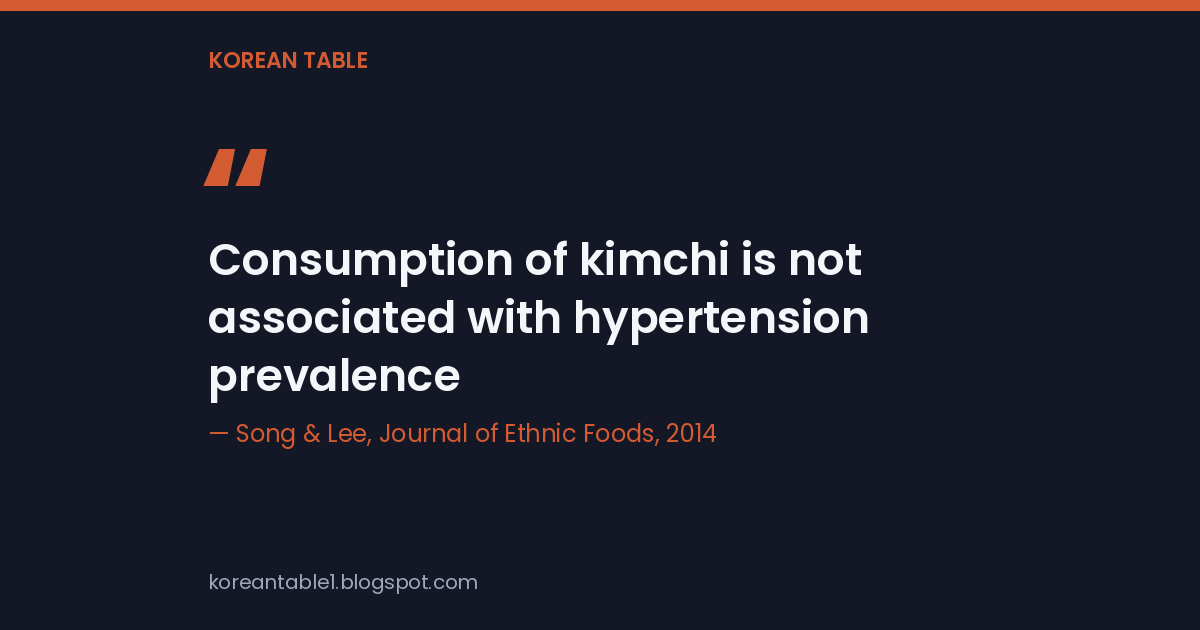
The paper to argue about is titled Consumption of kimchi, a salt fermented vegetable, is not associated with hypertension prevalence. Hong Ji Song and Hae-Jeung Lee published it in the Journal of Ethnic Foods, volume 1, issue 1, pages 8 to 12, in 2014.
They used the Korea National Health and Nutrition Examination Survey for 2007, 2008, 2009, 2010, 2011 and 2012, which gave them 20,114 adults, 7,815 men and 12,299 women. Kimchi intake came from a 24-hour dietary recall, the same instrument behind the consumption numbers in yesterday's post.
Comparing the heaviest kimchi eaters against the lightest, the odds ratio for hypertension in men was 0.87, 95% confidence interval 0.70 to 1.08, for 216.5 g a day or more against under 39.2 g. In women it was 1.04, confidence interval 0.80 to 1.34, for 145.1 g or more against under 19.5 g.
Both intervals contain 1. The top male group ate at least 216.5 g of kimchi a day, more than five times the 39.2 g ceiling of the bottom group, and was not measurably more hypertensive. The women's comparison came out the same way.
The authors' own reading of it: "high potassium intake due to high consumption of kimchi may have helped neutralize the effect of elevated sodium intake on blood pressure levels."
Two cautions before using this as a defence. The study is observational and its abstract describes a survey rather than a follow-up over time, so it cannot say which caused which. And I read the abstract record rather than the full text, so the adjustment variables are outside what I verified.
The rat study that separates the salt from the kimchi
Seung-Min Lee and colleagues at Korea University took the question into an animal model in 2012. Their paper ran in Nutrition Research and Practice 6(4), pages 315 to 321. Eight rats went into each of five diet groups: normotensive Wistar-Kyoto controls, spontaneously hypertensive rats on a plain diet, and three more hypertensive groups whose feed was supplemented with freeze-dried kimchi at 1.4%, 2.4% or 3.0% salt by wet weight. Blood pressure was measured over six weeks.
The 1.4% and 2.4% batches were Chongga products. The 3.0% one is what the paper calls home style, "generally prepared and served by Korean housewives." Each rat got the equivalent of 1 g of wet kimchi a day.
Their result: the rats "showed higher blood pressure compared to that in WKY rats, which was further elevated by consuming high sodium containing kimchi but was not influenced by supplementing with low sodium kimchi."
Three of the seven authors list DAESANG FNF Corporation, the company behind Chongga, as their affiliation, and the batch that raised blood pressure was the home-style 3.0% one. The paper prints all of that in its author list and methods.
In this design the food stays constant and only the salt level moves. The human survey had no way of arranging that. Rats bred to be hypertensive are still not you, and six weeks of feeding is not a diet. Kimchi did not increase cardiac or left-ventricle mass in those rats either.
Your jar is not the national average
The 593 mg gets slippery here, because it came from side dishes sampled around Seoul in 2017 while your jar was made by one company in one month.
A WiKim team under senior researcher Seo Hye-young (서혜영 책임연구원팀) collected 16 commercial products from eight Korean manufacturers between June 2021 and February 2022. The study ran in the Korean Journal of Food and Nutrition as 「시판 배추김치의 나트륨 함량 모니터링」, and 대한급식신문 reported it on 9 February 2023. Company averages ran from 534 to 783 mg per 100 g, and the two smallest manufacturers by revenue came out highest. At the extremes, one baechu kimchi measured 856 mg against another at 434 mg, close to double.
Season moved the number as much as the brand did. Spring and summer kimchi generally carried less sodium than autumn and winter kimchi, and within a single manufacturer the seasonal gap reached 26.8% to 64.3%. Seo's team gives the reason. "계절별 나트륨 함량이 다른 이유는 배추의 품질에 따라 절임에 필요한 소금량이 차이가 나기 때문." The salt needed for brining changes with the quality of the cabbage.
Food and Drug Safety Ministry rules say a measured sodium value has to come in under 120% of what the nutrition panel declares, and most of these products did not hold that line. The article words the comparison in the opposite direction from the rule it quotes, so I am using the ministry's wording.
A 2019 survey by the consumer group 소비자시민모임, reported by 푸드아이콘, tested 15 packaged baechu kimchi products and found an average of 569.58 mg per 100 g, which it put at 28.5% of the 2,000 mg daily reference value. The lowest was 비비고 포기 배추김치 at 467.33 mg and the highest 아워홈 아삭김치 포기김치 at 691.95 mg. One of the fifteen came in anywhere from 379.77 to 552.98 mg depending on which day it was made, a spread of 45.6%.

What you can check yourself
Read the sodium line per 100 g rather than per serving, because serving sizes differ between brands and only the per-100-g figure compares across jars. Between the saltiest and the least salty product on a Korean shelf the gap ran close to two to one, 856 mg against 434 mg.
If you make kimchi at home, the salt is a dial you hold. Hwang Eun-Sun and colleagues, writing in the Korean Journal of Food Science and Technology 48(5), pages 413 to 417, in 2016, compared a regular kimchi at 1.99% salinity against a reduced-salt version at 1.56%, a 21.6% reduction. Their sensory panel preferred the low-sodium kimchi and rated it less salty than the standard one. Those salinity figures were measured on day 1 after manufacture.
None of these sources reaches the kimchi in the banchan dish at a restaurant. It carries no nutrition panel, and none of the surveys above sampled restaurant kimchi. Every figure on this page describes either side dishes bought in Seoul in 2017 or packaged products collected for a study.
So the question was never whether kimchi contains a lot of sodium. It contains 593 mg per 100 g, and the survey of 20,114 adults still found no association with hypertension.
Which brand is in your refrigerator, and what is the sodium per 100 g on its label? I would like to know whether the two-to-one spread holds outside Korea too.
This is a running series, not a one-off post — a new post goes up every day, at around 9am Korea time.
About · Contact · Privacy Policy
Read next: Kimchi Every Day? 22.7% of Korean Adults Ate None Yesterday · Fish Sauce Substitutes r/fermentation Readers Use in Kimchi · Kimchi Probiotic Counts by Fermentation Stage


Comments
Post a Comment