Kimchi Every Day? 22.7% of Korean Adults Ate None Yesterday
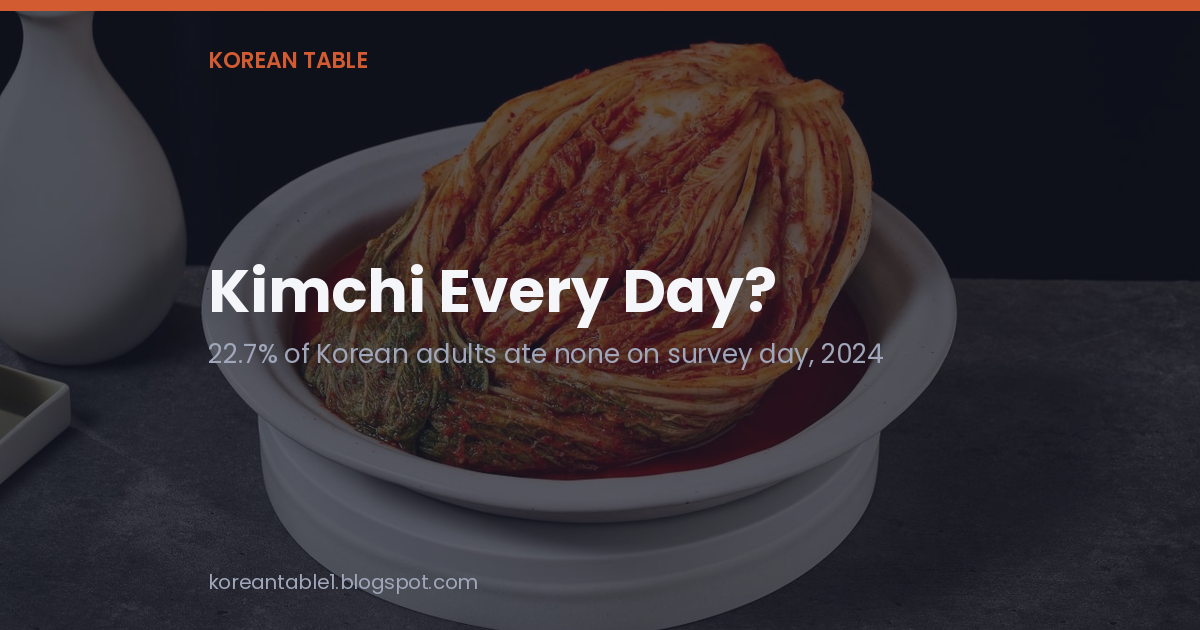
People say it in every thread about Korean food. Koreans eat kimchi at every meal. A paper published in June 2026 in the Korean Journal of Community Nutrition put a number next to it. Among 103,267 adults surveyed between 2010 and 2024, the share reporting no kimchi at all on the previous day went from 11.7% to 22.7%.
Just over one adult in five, on any given day.
Where the number comes from
The study is by Hui-Yang Zhao, Hyunji Ham, Sumin Kim, Chang Hyeon Lee, Kyungho Ha and Sangah Shin, working across Chung-Ang University, Jeju National University and the World Institute of Kimchi (세계김치연구소), and it is open access on PMC. Their data is KNHANES, the Korea National Health and Nutrition Examination Survey, covering its 2010 to 2024 rounds.
The intake figure comes from a 24-hour dietary recall, a record of what a person ate in the previous day. So 22.7% counts people who happened to eat none in one particular day, and it says nothing about whether they have kimchi in the fridge. The authors state the figure directly. "The proportion of individuals reporting no kimchi intake on the 24-hour recall day increased from 11.7% in 2010 to 22.7% in 2024."
Split by sex, men went from 10.2% to 20.6% and women from 13.1% to 24.8%. Women started higher and stayed higher, which runs against what I would have guessed.
Average daily intake fell too. 농민신문 reported the same study in Korean on 9 August 2026: "하루 김치 섭취량도 2010년 109.6g에서 2024년 90.3g으로, 14년새 19.3g(17.6%) 줄었다." Daily kimchi intake dropped from 109.6 g to 90.3 g, a loss of 19.3 g or 17.6% over fourteen years. Baechu kimchi alone went 71.1 g to 59.3 g.
For scale, the paper classifies intake against "the single-serving recommended intake of 40 g/day as specified in the Dietary Reference Intakes for Koreans." By that yardstick 90.3 g is a little over two servings, and that conversion is my arithmetic rather than the paper's.
Young adults moved it into the pot
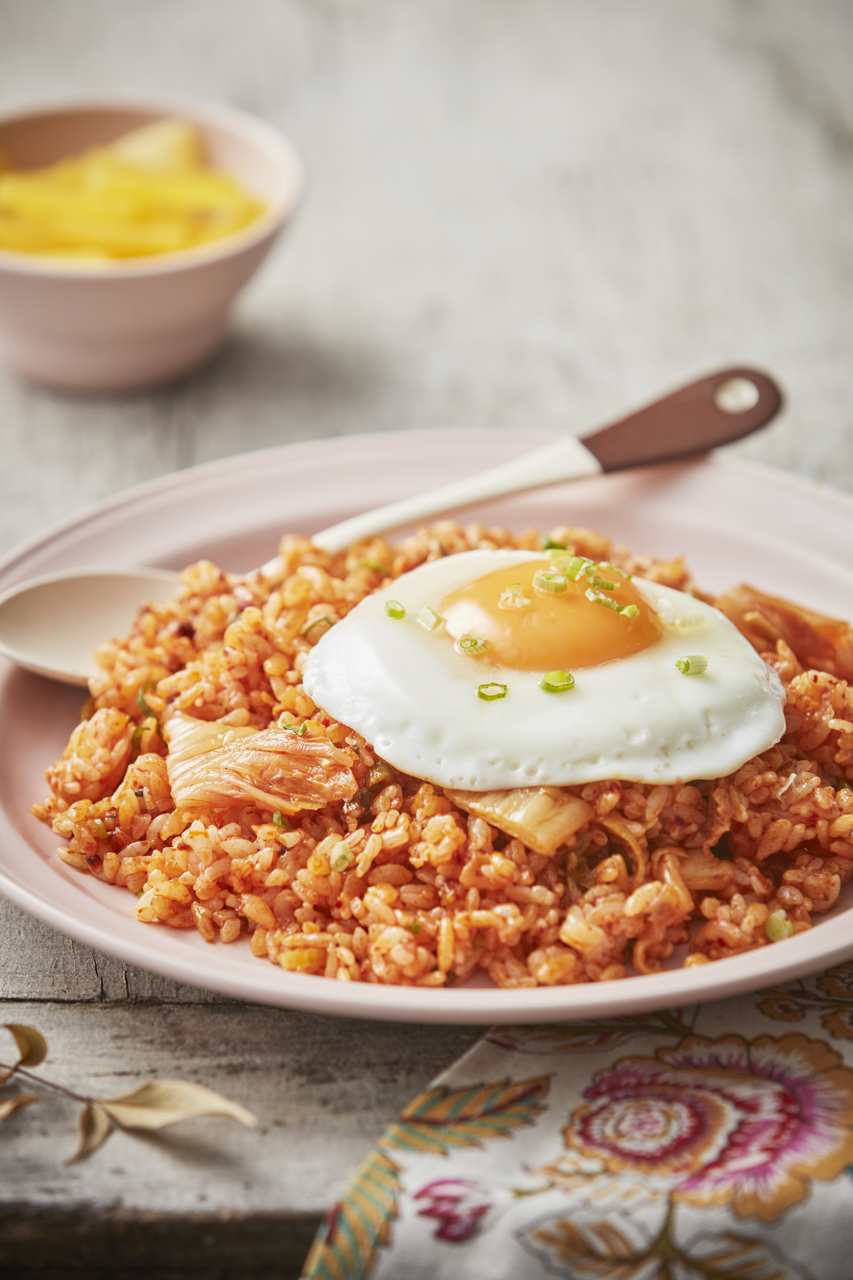
The finding I did not expect is in the youngest adult band. Among 20–39 year olds the paper reports kimchi eaten as a side dish declining (β = −0.888) and kimchi eaten as an ingredient inside another dish rising by exactly the same figure. "Among young adults (20–39 years), a qualitative shift occurred as consumption transitioned from side dishes to dish ingredients," the authors write.
Anyone who has shared a flat with Korean twenty-somethings will recognise this. Kimchi-jjigae, kimchi-bokkeumbap, kimchi-jeon, kimchi on the instant ramyeon. The jar gets opened; the little dish of kimchi never reaches the table.
Who still eats 100 grams a day
The pattern by household income runs opposite to what the "kimchi is peasant food, Koreans are richer now" version of this story would predict. In the 2022 to 2024 factor analysis the lowest income group ate 116.92 ± 3.04 g a day and the highest 95.57 ± 1.99 g.
Age pulls the same way. Adults aged 65 and over were more likely to clear the 40 g mark, at an odds ratio of 1.52. People who ate alone twice or more a day were less likely to clear it, at 0.67 among 30–64 year olds. "Future strategies for preserving traditional food culture and establishing nutritional policies must be tailored to reflect modern dietary changes, such as an increase in single-person households and the spread of a solo-dining culture," the authors conclude.
None of this is new in direction. An earlier analysis in the Journal of Nutrition and Health (Jeong, Park, Lee, Hong and Shin, 2023, 56(4):404–418) tracked 81,680 adults aged 30 and over from 1998 to 2020 and found baechu kimchi intake falling in both sexes, β = −1.606 for men and −1.996 for women. 대한급식신문's write-up of that study gives per-sex gram figures as well, but the article never says whether those cover all kimchi or baechu only, so I have left them out.
The restaurant kimchi question
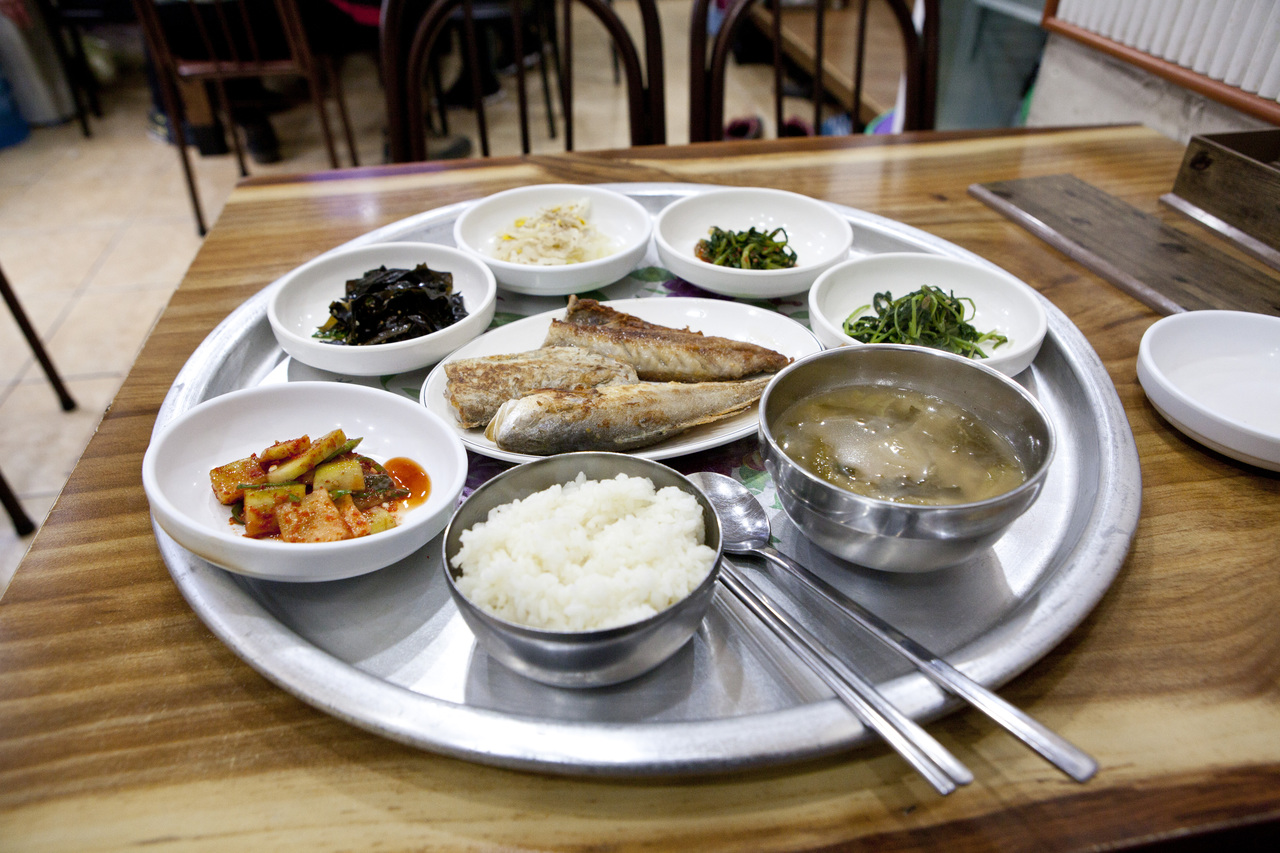
The other half of this argument, the one that runs in Korean comment sections rather than English ones, is where restaurant kimchi comes from. 헤럴드경제 reported on 26 August 2026 that Chinese kimchi imports hit 336,221 tonnes in 2025, the highest on record, with 194,401 tonnes already landed by July 2026 and 39.7% growth from 2021 to 2025. Those figures are credited to Korea Customs Service trade statistics.
The same article cites the Korea Rural Economic Institute's 2025 kimchi industry survey: 44.1% of restaurants serve imported kimchi as a side dish, up from 28.1% in 2020, and imported kimchi makes up 51.0% of the kimchi used for cooking. Among the businesses buying it, 49.0% gave price as the reason.
Korea also now buys more kimchi than it sells. 서울신문 reported customs figures of $159.46 million in imports against $137.39 million in exports for January to October 2025, and noted that essentially all of the imported kimchi is Chinese.
What you can check yourself
If you want to read the survey rather than take my summary of it, the 2026 paper sits on PMC with no paywall, and its tables carry the intake figures by year, sex, age group and household income. The Korean-language news coverage is where the round gram figures come from, and those two sources disagree on nothing I could find.
What I cannot tell you from any of this is what a household in Korea looks like now, because a 24-hour recall gives you the day and not the kitchen. The survey can say 22.7% of adults ate none yesterday. Whether any of them opened a jar the next morning sits outside what a one-day recall records.
So, a question back to you, especially if you cook Korean food outside Korea. I would expect your own split to land near the twenty-somethings in this paper, with more of the jar going into a pot than onto a plate. Of the kimchi you buy in a year, how much of it ever reaches the table as a side dish?
This is a running series, not a one-off post — a new post goes up every day, at around 9am Korea time.
About · Contact · Privacy Policy
Read next: Is Kimchi Too Salty? 593 mg of Sodium per 100 g · Fish Sauce Substitutes r/fermentation Readers Use in Kimchi · Kimchi Probiotic Counts by Fermentation Stage


Comments
Post a Comment