Gochugaru Heat Grades: 93 Bags Tested, 51% Matched the Label
Gochugaru (고춧가루) is the coarse, deseeded Korean chili flake that gives kimchi and most red Korean stews their color. Korean bags carry a heat word on the front, one of 순한맛, 덜매운맛, 보통 매운맛, 매운맛 and 매우 매운맛. Those five words are a national standard with a milligram figure behind each one. The Ministry of Agriculture, Food and Rural Affairs revised them into the processed-food KS standard and published the result on 31 December 2013, as Food Today reported at the time.
The five bands, in mg/kg
Grade comes from capsaicinoid content per kilogram of powder. The 2014 newspaper coverage wrote the unit as ppm, which is the same figure as mg/kg here.
| Bag wording | Rough English | Total capsaicinoid |
|---|---|---|
| 순한맛 | mild | under 150 mg/kg |
| 덜매운맛 | slight hot | 150–300 mg/kg |
| 보통 매운맛 | medium hot | 300–500 mg/kg |
| 매운맛 | hot | 500–1,000 mg/kg |
| 매우 매운맛 | very hot | 1,000 mg/kg and over |
Kimchi got three bands on the same day on a much smaller scale, mild under 2.9 ppm, medium from 2.9 to 14.9, hot at 14.9 and over. Producers were given a two-year grace period before the wording applied. Food Journal also reported the market snapshot the ministry worked from. Of the gochugaru the ministry had figures for when it set the bands, 12% fell in the mild band, 35.5% slight, 33.5% medium, 17% hot and 2% very hot.
What 93 bags measured
Ahn and colleagues, writing in the Korean Journal of Food Preservation in 2022, bought 93 gochugaru products online between August and November 2021 and ran HPLC on every one. Capsaicin came in between 35.9 and 1,029.5 mg/kg, dihydrocapsaicin between 22.4 and 472.3, total capsaicinoid between 60.7 and 1,402.0 mg/kg. The hottest bag in the set held roughly 23 times the capsaicinoid of the mildest.
Eighty-eight of the 93 carried a pungency word on the package. Of those 88, the paper puts 51.1%, or 45 bags, in the KS band their measured content put them in. The misses ran both ways. Six samples measured above the band their printed grade allowed, numbers 27, 28, 36, 72, 73 and 79, and a longer stretch measured below it, numbers 29, 30, 37 to 64, 74 to 76 and 80 to 83.
Sorted by measurement instead of by label, the 2021 set skewed mild. The paper puts 39.8% under 150 mg/kg, 30.1% in the slight band, 10.8% medium, 7.5% hot and 11.8% very hot. Those two distributions were collected differently, though, the ministry's from the market figures behind the 2013 standard and the paper's from 93 online purchases in 2021, so the gap between them is not a clean time series.
In Scoville terms, roughly
English-language recipe writing runs on Scoville numbers, and the conversion carries a caveat worth stating before the arithmetic. The factor comes from pure capsaicin's own rating, so applying it to a total capsaicinoid figure is an approximation. Wikipedia's Scoville scale entry gives the ASTA conversion as ppm × 15, with a footnote recording that some sources use × 16 to match the 16,000,000 SHU figure for pure capsaicin, and that the source those authors lean on states 15 per ASTA.
At × 15, the mild ceiling of 150 mg/kg lands near 2,250 SHU. The hot band, 500 to 1,000, spans roughly 7,500 to 15,000. The hottest bag in the 2021 set, at 1,402 mg/kg, works out to about 21,000. The same Wikipedia page puts jalapeño at 2,500 to 10,000 and cayenne at 25,000 to 50,000, which puts the mild band under jalapeño's floor, the slight and medium bands inside jalapeño's range, and even that 1,402 mg/kg outlier below where cayenne begins.
Cheongyang pepper is where the sources I opened disagree outright. Nongchon Yeoseong Sinmun's 2014 write-up of the same KS revision puts it at 4,000 to 12,000 SHU; Wikipedia's table says 10,000 to 25,000. I could not find a measurement that reconciles the two, so both numbers go here as they were printed.
Why a bag can carry the wrong word
KS certification is voluntary. The clause the marking hangs on is Article 15(2) of the Industrial Standardization Act, summarized by the Korea Ministry of Government Legislation, under which a producer who has been certified "may" mark the product, its packaging, its container, its delivery note or its warranty as conforming to the Korean Industrial Standard.
There is a precedent for how the split works in practice. When the ministry brought gochujang into a five-level heat grading scheme, Nongmin Shinmun reported in May 2010 that the labeling would apply mandatorily to the 14 KS-certified gochujang products from 1 January the following year, while uncertified makers would take part voluntarily. I looked for an equivalent sentence about gochugaru and did not find one, so whether chili powder splits the same way is a gap I could not close from public sources.
At the shelf, and when you run out
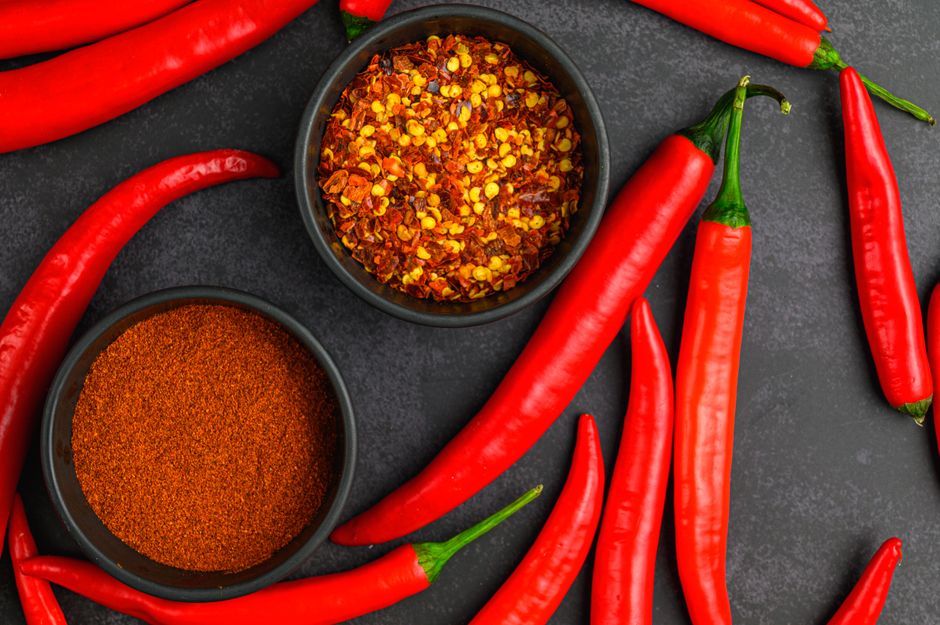
The grade word says nothing about flake size or freshness. Buy the smaller bag if you cook Korean food twice a month and keep it in the freezer, because a bag left open in a warm cupboard since last winter will taste flat whatever it once measured. Kimchi takes the coarse grind, sold as 김치용, while stews and sauces take the fine one, 고운 고춧가루.
For substitutes, Corrie Cooks' guide sets Aleppo pepper powder at one teaspoon per teaspoon of gochugaru. That page gives no capsaicinoid figure behind the swap and does not single out kimchi, and the 2021 study covered Korean-market bags only, so the ratio is a texture and color match with the heat left unmeasured. On the paste-versus-powder question, the earlier post on gochujang and gochugaru put gochugaru at 1,500 to 10,000 SHU from a secondary source; the KS bands above are the primary version of that number and they run higher at the top.
Go and look at the bag in your own kitchen. Is the heat marking one of those five Korean words, a milligram figure, an English "hot / medium / mild," or nothing at all? The bags sold outside Korea are the part of this I have no data on.
This is a running news series, not a one-off post — new stories go up twice a day, roughly 7am and 7pm Korea time.
More Korea coverage from our network: Hallyu Now · Korea Travel Planner · K-Sports Global · Seoul Skin Notes


Comments
Post a Comment