Are Korean Side Dishes Free? Banchan Refills and the Reuse Law
Banchan (반찬) are the small shared plates that land on the table before your order, and they are why Korean side dishes have a reputation for being free. The refill is free as well. The phrase for it is 반찬 좀 더 주세요 (banchan jom deo juseyo).
Korean restaurant owners voted this year on whether the free refill should continue. Korean food law carries one sentence about what a restaurant may do with a bowl a customer sends back half full, plus a list of exceptions to it that runs to four groups.
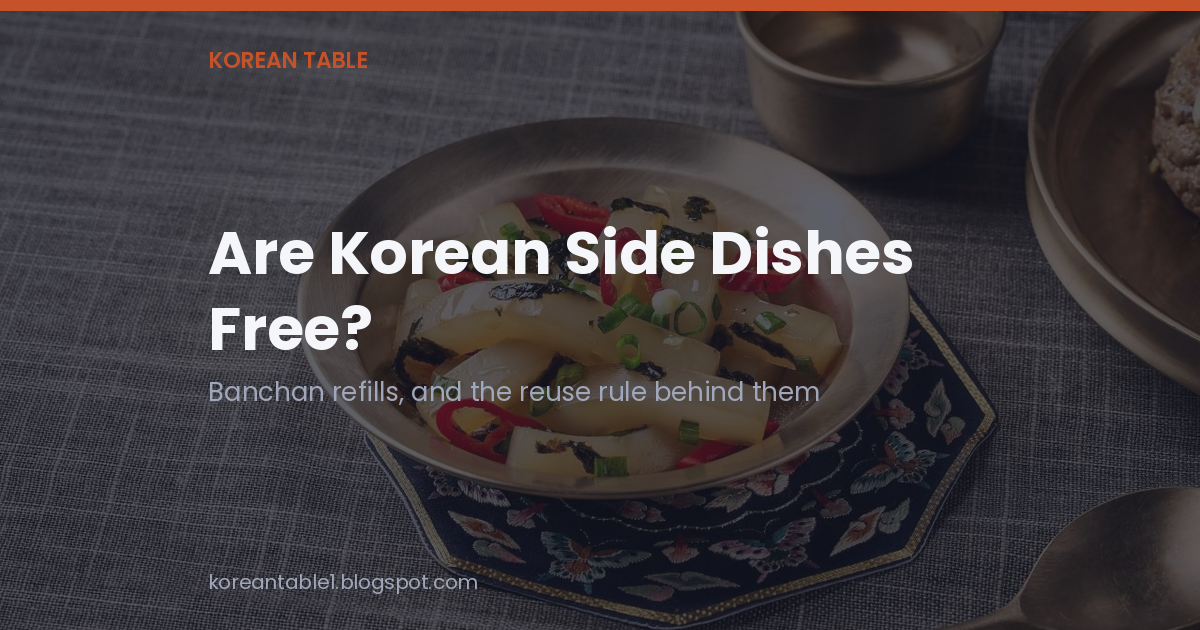
The refill is free, and owners voted on keeping it that way
머니투데이 reported on 3 February 2026 that 아프니까 사장이다, a large forum for Korean small-business owners, ran a poll on charging for extra banchan. Voting opened on 25 January. 523 owners, 38.5%, backed charging. 836, or 61.5%, were against.
The winning side's reasoning was not about generosity. The pro-charging comment the paper quoted is a complaint about waste, from owners who will refill for someone who finishes the plate and resent refilling for someone who asks for a pile and leaves most of it. What the opposition kept returning to was that no single restaurant can move first. One comment ran 국민 정서상 전국 모든 음식점이 동시에 시행하는 거 아니면 절대 불가능하다, which translates as, unless every restaurant in the country starts on the same day, public feeling makes it impossible.
Another commenter claimed Korea is the only country where extra side dishes are free. The article did not check that, and I couldn't either.
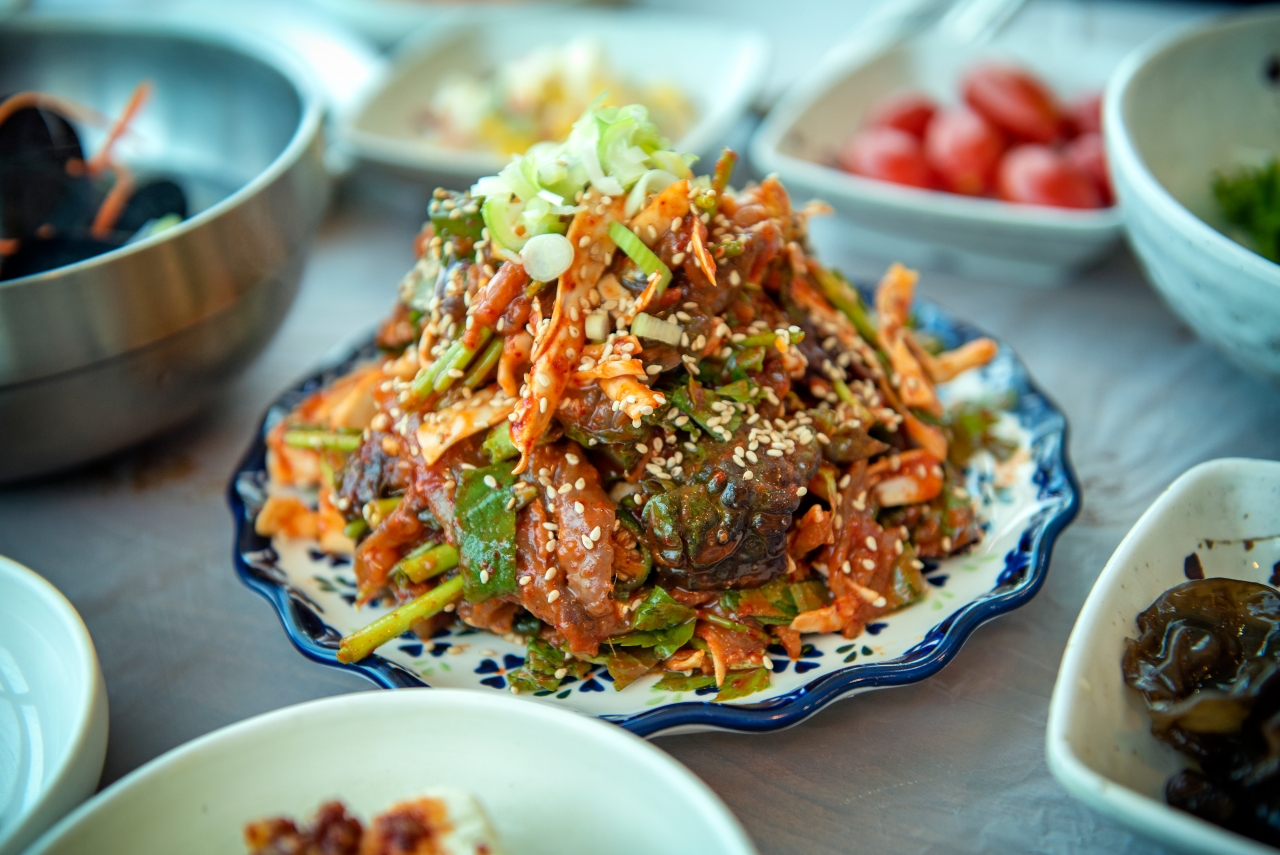
What the law lets a restaurant do with what a customer leaves
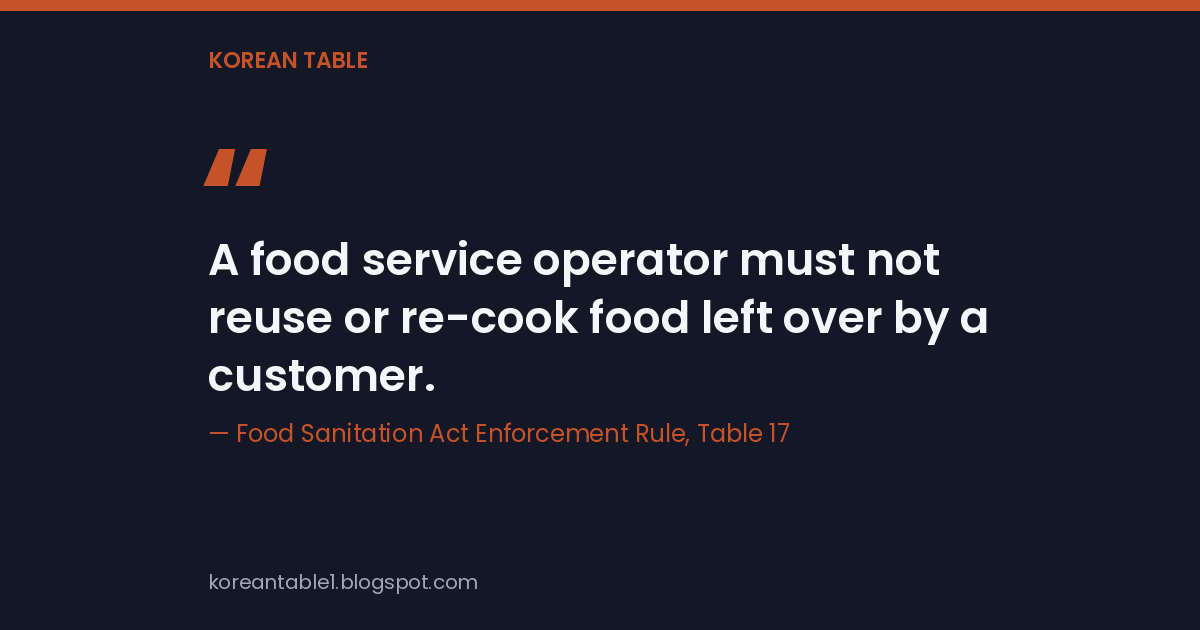
The rule lives in Table 17 of the Enforcement Rule of the Food Sanitation Act, the schedule of duties every licensed food business signs up to. Rendered in English, a food service operator must not reuse or re-cook food a customer has left. The Korean sentence quoted in a 2010 administrative ruling is 식품접객영업자는 손님이 먹고 남은 음식물을 다시 사용·조리하여서는 아니된다.
Two sets of penalties hang off that one line. 찾기쉬운 생활법령정보, the government's plain-language law portal, puts the criminal maximum at three years in prison or a 30 million won fine, under Article 97(6). The administrative track is the one owners talk about. 한국외식신문, a restaurant trade paper, gives 15 days of business suspension for a first offence, two months for a second, three months for a third.
That 15 days is not hypothetical. In 국민권익위원회 case 행심 제2010-031호, decided 23 February 2010, a Busan restaurant was caught in a joint inspection on 11 December 2009 with leftover baek-kimchi from customers' tables collected in a ceramic bowl and kept in the fridge that holds the kimchi served to customers. The owner asked for the suspension to be cancelled. The commission found nothing unlawful or unfair in it and let the 15 days stand.
Enforcement at scale is harder to read. 아시아경제 counted 183,371 administrative actions against food businesses over 2015–2020, of which 46,833 were breaches of operator duties, the single largest category. Table 17 holds dozens of duties besides food reuse, so that figure is an upper bound for reuse cases.
The list of things that can go back out
식품의약품안전처, Korea's food safety ministry, posted a guidance document titled 음식 재사용 기준 및 뷔페음식점 등 위생가이드라인 on 26 June 2019, through its 식품안전관리과. The list below is the one 한국외식신문 and 위키트리 both reproduce, and their versions agree. The reuse-standards attachment on the ministry's own page, 음식 재사용 기준.hwp, is a .hwp file I could not open.
Four groups may go back out.
- Vegetables and fruit that have been through no cooking and no mixing with seasoning, washed before they go back out, among them lettuce, perilla leaves, whole chillies, whole garlic, cherry tomatoes, grapes and kumquats.
- Food whose skin is intact and unbroken, such as bananas, tangerines, lychees, peanuts and walnuts.
- Dried processed food set out for people to help themselves, including nuts, crackers, chocolate and breads.
- Salt, pepper and other seasonings, plus kimchi and rice, when they sit in a covered container served with tongs.
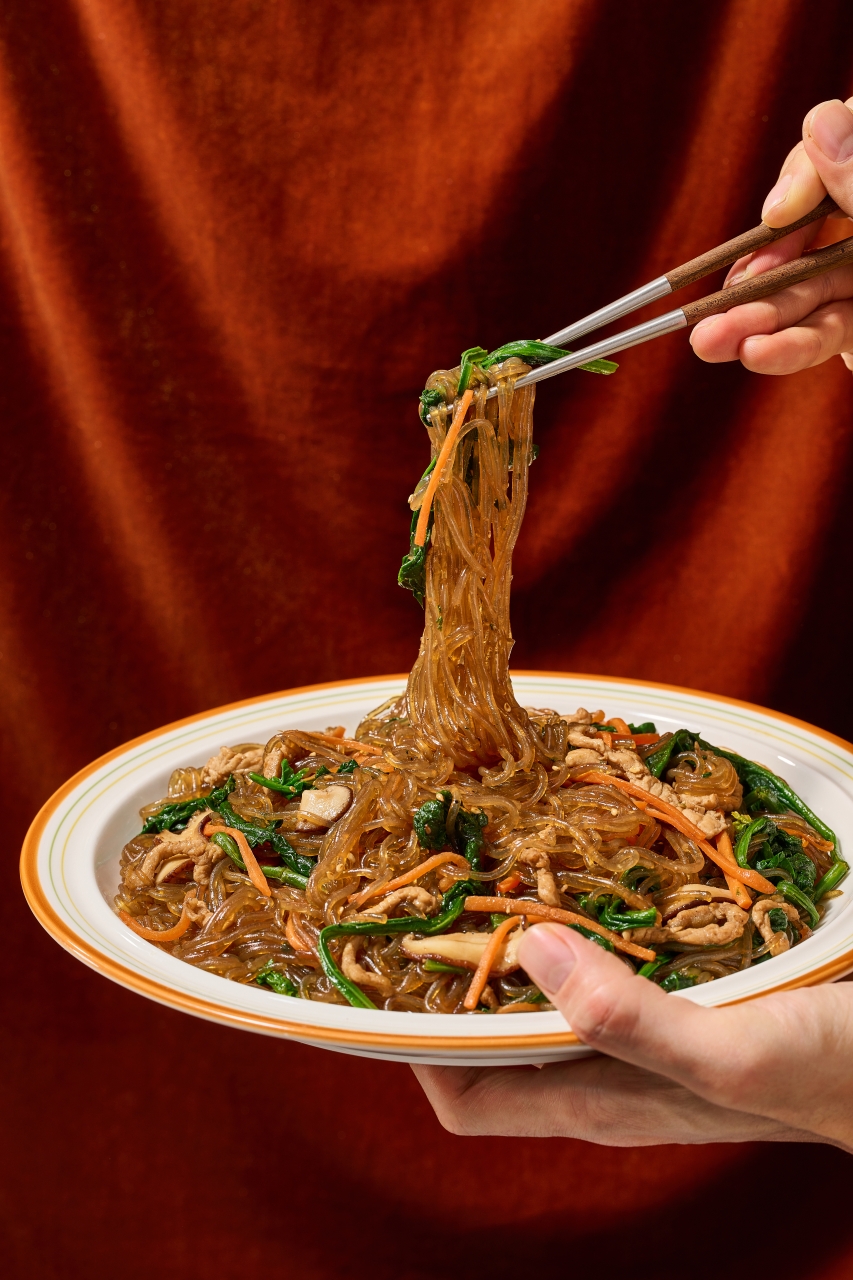
The same guidance names what cannot go back out. Raw fish, sushi, gimbap, gejang, cut fruit such as watermelon and orange, cream-filled cakes and pastries, fried food left out in the air for a long time, and japchae. Whether that 2019 list has been revised since, I could not confirm.
Set the two lists side by side and the container matters more than the ingredient. Groups three and four qualify only while the food is set out for customers to help themselves. Neither list covers a bowl of seasoned mu-saengchae set in front of one person at a 백반 place. Group four does cover the tub of kimchi that sits under a lid with tongs at a 뷔페.
What this is worth knowing when you order
Ask for the refill. The people who pay for the banchan argued the economics out in public and voted to keep giving it away, 836 to 523.
None of this establishes how common reuse is. A single 2010 case and a six-year enforcement total do not make a rate, and I found no survey that measured one.
The rules also stop at the border. A Korean restaurant in Chicago or Manchester runs on its own policy and its local health code, and Korean law has nothing to say about the second bowl in either city.
Has a Korean restaurant outside Korea ever charged you for a second bowl of kimchi, and did the menu say so before it arrived?
This is a running news series, not a one-off post — new stories go up twice a day, roughly 7am and 7pm Korea time.
More Korea coverage from our network: Hallyu Now · Korea Travel Planner · K-Sports Global · Seoul Skin Notes


Comments
Post a Comment