Budae Jjigae (Army Stew): Uijeongbu Style vs Songtan Style
Budae-jjigae (부대찌개), the "army base stew," is the one Korean stew where a regular Western supermarket already stocks most of the pot. The Korean aisle only has to supply the kimchi and the gochugaru; the rest is Spam, hot dogs, bacon, baked beans, a slice of American cheese and a packet of instant noodles.
What most English recipes skip is that Korea has two named versions of this stew, and they don't taste the same. One comes from Uijeongbu, north of Seoul, and runs clear and kimchi-forward. The other comes from Songtan in Pyeongtaek, next to the Osan air base, and is thick with cheese and beans. The Korean sources I read this week disagree with each other on one point, which I'll get to.
Where the stew came from, as far as anyone can tell
The Korean Wikipedia entry on 부대찌개 says outright that the exact single birthplace and date are hard to pin down (정확한 단일 발상지와 발명 시점은 확정하기 어렵다). Several towns with US bases after the Korean War developed their own versions. The page lists Uijeongbu, Songtan, Paju, Gunsan, and Yongsan in Seoul, where it was sold as "Johnson-tang" (존슨탕), and gives as one theory for that name Lyndon B. Johnson's visit to Korea in October 1966.
Food columnist Yoo Ji-sang, writing in Korea Aviation News in July 2024, describes the raw material as 부대고기, "base meat," the sausage and ham that "slipped out through the wire fence" of American bases and got boiled with kimchi and a few spoonfuls of gochujang. He also notes that the Uijeongbu version started as a stir-fry sold with drinks (부대볶음), and that the jjigae only took over as the main item after the 1988 Seoul Olympics.
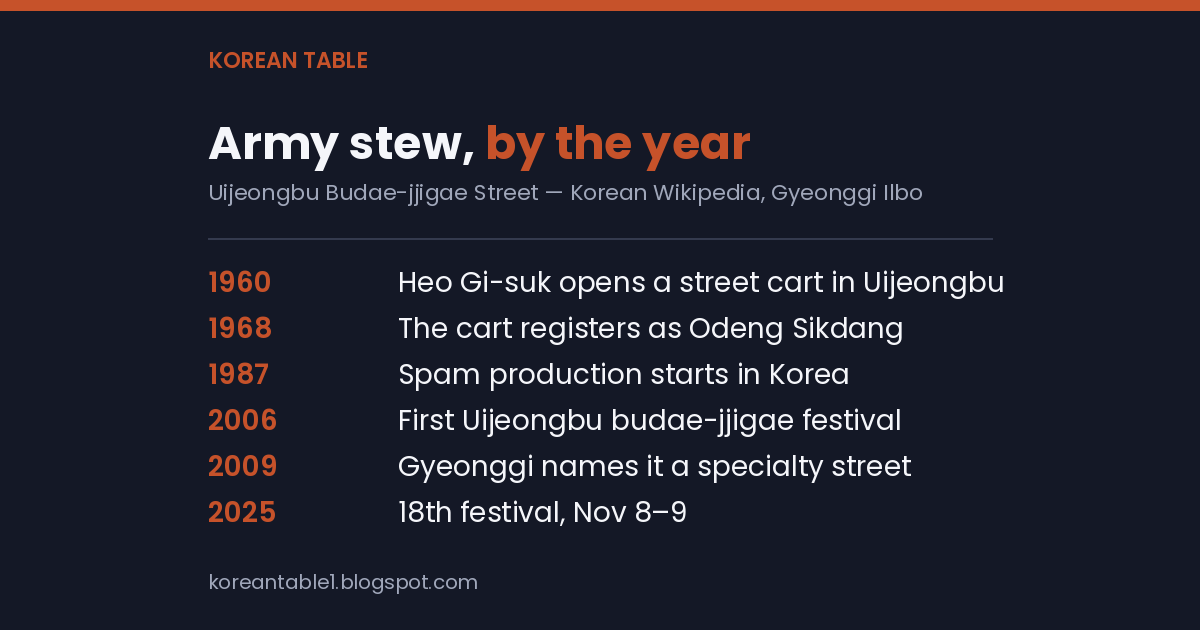
The shop Uijeongbu credits as its original is Odeng Sikdang (오뎅식당). Per the same Wikipedia entry, its founder Heo Gi-suk ran a street cart there from 1960 and registered the "Odeng Sikdang" name in 1968. Domestic Spam production in Korea didn't start until 1987.
Uijeongbu style, the clear one
Yoo's column says the Uijeongbu pot is boiled on a kimchi base and so has no thickness to it (점성 없이 깔끔한 맛). Wikipedia describes the same style as a clear broth with a moderate amount of sausage and ham, where the kimchi flavor comes through, 개운하고 맑은 맛, refreshing and clear.
The Uijeongbu Budae-jjigae Street page has the numbers on the street itself. It sits along Hoguk-ro 1309beon-gil and Taepyeong-ro 137beon-gil in Uijeongbu-dong. Around 20 shops in 2002; a 470-metre stretch was redone in 2008; Gyeonggi Province designated it a budae-jjigae specialty street in 2009; the city lists 12 specialist restaurants as of 2026. Nearest station is Uijeongbu Jungang on the Uijeongbu LRT, which opened on July 1, 2012.
If you're cooking at home and want this end of the spectrum, Hyosun's recipe at Korean Bapsang is the closest I found among English-language recipes. Her pot for four uses 2 cups of napa kimchi, 2 hot dogs, 3 strips of bacon, a third of a can of Spam (about 4 oz), 4 oz of tofu, and 4 cups of anchovy broth, seasoned with 1 tablespoon gochugaru, 1 teaspoon gochujang, 1 tablespoon soup soy sauce and 1 tablespoon minced garlic, cooked about 15 minutes. One teaspoon of gochujang in four cups of broth.
Songtan style, the cheese-and-beans one
Songtan is the north-east part of Pyeongtaek, and Korean Wikipedia dates its base town to 1952, when the US airfield now called Osan Air Base went in during the war. Wikipedia has its stew using far more sausage and ham, plus cheese, with tomato sauce and baked beans going in together. Yoo's column calls the result 기름지고 진하며 걸쭉한 맛, oily, deep and thick, and says the canned beans and cheese go in after the ham, sausage and vegetables and get boiled until the red broth turns orange (주황빛).
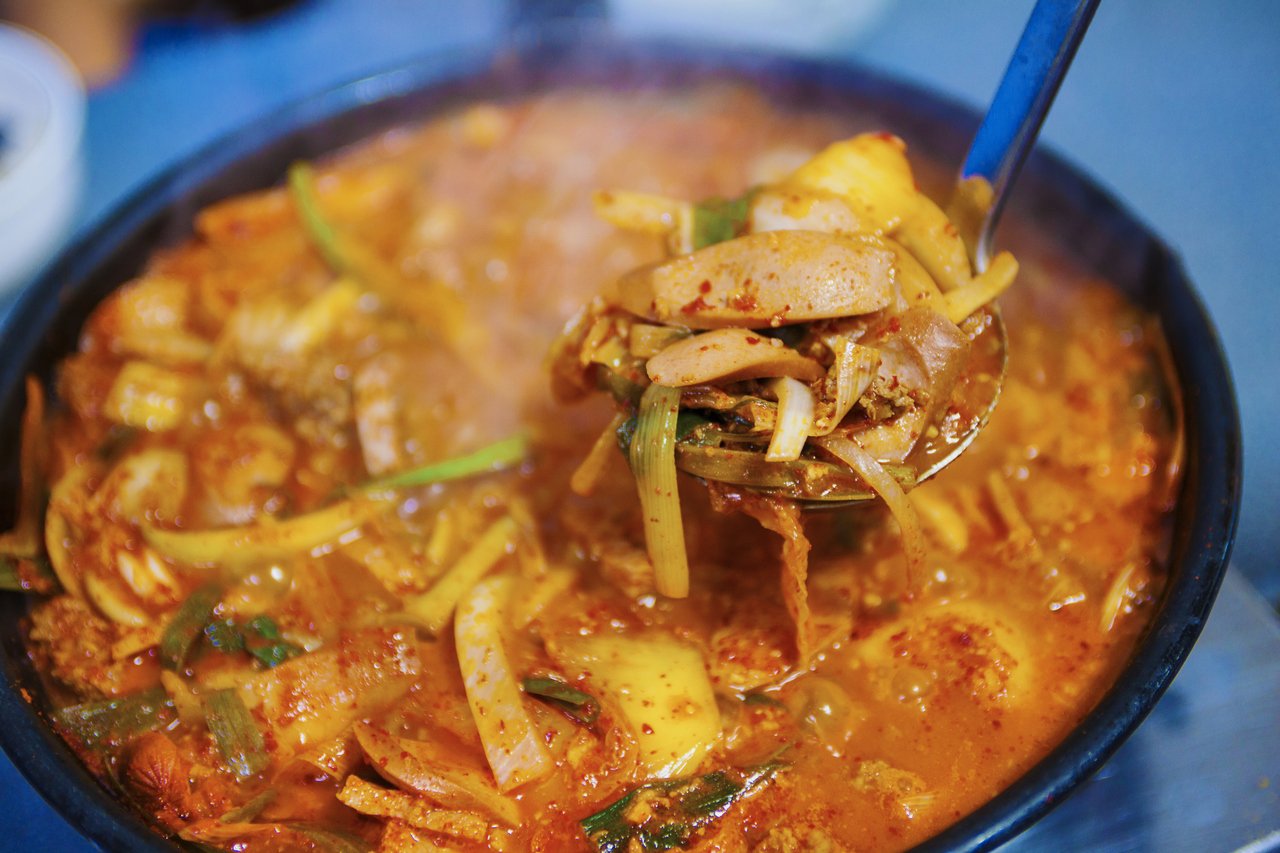
For a Korean-language recipe of this style, 요리픽 (Cookpick) posted one in October 2025. Their 3-to-4-serving pot uses 200 g Spam, 10 Vienna sausages, 100 g bacon, one 400 g can of baked beans, 200 g kimchi, 2 packets of ramyeon noodles, 100 g tteokbokki rice cakes, half a block of tofu, 4 slices of cheese, and 800 ml of water. Their seasoning is 3 tablespoons gochugaru, 3 tablespoons soy sauce, 2 tablespoons cooking wine, 1 tablespoon each of minced garlic, sugar and tuna extract (참치액). Against Hyosun's pot that is roughly double the processed meat, a full can of beans, cheese on top, and about the same liquid per serving (800 ml for three to four bowls against 4 cups for four). Their noodles and cheese go in for the last 2 to 3 minutes of a roughly 10-minute boil.
The sources split on one point. Cookpick's comparison table says the Songtan version uses no gochujang at all, only gochugaru and soy sauce, and therefore has the clearer, lighter broth, while it files the thick, sweeter, gochujang-based soup under Uijeongbu. That is the reverse of what both Wikipedia and Yoo's column say. Reading the three side by side, I think Cookpick is describing the seasoning base (its own Songtan recipe has no gochujang in it, which checks out) while the encyclopedia and the columnist are describing what ends up in the bowl, where a can of beans and four slices of cheese make any broth thick regardless of the paste. But I have not eaten at the Songtan shops, so I can't say which chart a local would sign off on.
Shopping outside Korea
Spam, hot dogs, bacon, baked beans and sliced cheese come from any supermarket. A Korean grocer such as H Mart covers the ramyeon, the tteokbokki rice cakes, the kimchi and the gochugaru.
On the beans, I read Cookpick's 베이크드빈 통조림 as the beans-in-tomato-sauce kind, which is what a 400 g Heinz tin is in the UK or Australia. Beans canned in plain water would leave you adding the tomato and the sugar back yourself.
On the cheese, Cookpick's recipe names 슬라이스 치즈, sliced cheese, which on a Korean shelf means processed slices of the Kraft Singles type. I haven't tested a block cheddar in this stew, so I'd stay with the kind the recipe names.
The festival, and the date problem
Uijeongbu has run a budae-jjigae festival on the street since 2006. The 18th one, per 경기일보 (Nov 10, 2025), ran November 8 and 9, 2025, with free tasting at each shop, a ₩1,000 discount on a bowl, and a five-team cooking contest. Mayor Kim Dong-geun said it has "become the food festival that represents Uijeongbu." On the Korea Tourism Organization's page for the street, the festival is listed as every October. The 2025 edition was in November, and so was the third one in 2008 (also November 8–9, per the street's Wikipedia page), so if you're planning a trip around it I'd treat late October to mid-November as the window and watch the city site, ui4u.go.kr, for the 2026 date. I could not get the city's event pages to load today.
Which one to make first? With a jar of properly sour kimchi I'd go Uijeongbu, since the kimchi carries it; with young, mild kimchi, Songtan, since the beans and cheese don't need it to. Either way the noodles go in last, once everyone is at the table.
This is a running news series, not a one-off post — new stories go up twice a day, roughly 7am and 7pm Korea time.
More Korea coverage from our network: Hallyu Now · Korea Travel Planner · K-Sports Global · Seoul Skin Notes


Comments
Post a Comment